


The future user experience is agentic. You interact, and the agent goes and does some work.
That changes the economics, because every interaction requires accelerator compute (thinking) and CPU compute (doing & managing). This isn't just social/SaaS (mostly retrieving from a database), and it isn't just a chatbot. Per Anthropic’s S-1, agentic products “consume significantly more compute per user interaction than single-turn API calls or chat-based interactions.”
And as the world’s richest man showed us recently, the math has to math when agents are involved:

So who wins when agents are the interface?
The companies that can do two things at once:
Serve inference at the lowest possible cost.
Sell to customers who will pay a lot for what the agent does.
But… who actually pays for agents?
Consumers mostly don’t pay directly.
Sure, some of us pay $20, $100, or even $200 a month. Menlo’s 2026 survey found 55% of US AI users pay for at least one AI product. Of course, many, many here in the Midwest still aren’t regular AI users at all...
But paying for something isn’t the same as paying for agent-scale inference. It’s heavily subsidized still... $100 per month for thousands of dollars of tokens isn’t gonna make the math math... Your $20 plan doesn’t go far when you fire up agents, and that just goes to show how expensive agentic AI is.
So who will pay, if not consumers?
Businesses. And they’ll pay for your consumer usage! Hold that thought
First, enterprises pay directly when they can tie the spend to a productivity gain. Or a salary offset/reduction...
That’s why 79% of Anthropic’s revenue in the first nine months of 2026 ($26.3B) was usage-based, metered in tokens. Per the S-1, that growth came from customers spending $100,000 or more a year. Anthropic had more than 11,900 of them as of September 30, up from about 950 a year earlier! About 250 spend $10 million or more!
So are consumer businesses dead if they go agentic? It’s definitely a better UX when done right...
Not necessarily!
Take Meta, for example. The best way to make money from the 3.64 billion people who use Meta’s apps every day is the way Meta already does it! Let people use the product for free, and charge businesses for the right to put their products and services in front of them (i.e. ads).
Google, Meta and Amazon sold about $165B of ads in Q3 alone.
BuT aDs ArE DeAd! Look at Google’s last earnings call, right?
That take lacks imagination. High-intent conversations with AI are incredibly valuable for Google.
Yes, Google needs to experiment quickly to thoughtfully introduce ads, sponsored results, and so on. It’s gonna look different than today’s search. But all the ingredients are still there: users, attention, intent to purchase, etc.
There’s no reason to believe the ads business model is dead in the agentic experience.
Sure, you can ask if modern Google is capable of imagining and delivering this experience quickly. It’s OK to ask about Google’s execution. But the ads business model itself will still work when agents are the interface. And there’s lots of nuance, especially if agents are making some of the purchasing decisions… but there’s still an ad-business model here.
Anyway, back to monetizing inference.
Businesses pay for inference! Either directly through enterprise consumption or indirectly through ads and commerce.
If you can get enterprises to pay you directly for inference or you have an ad-based business model, agentic inference can math out for you. If you have both... glorious!
But that’s the top line. How to make sure all those dollars flow to the bottom line?
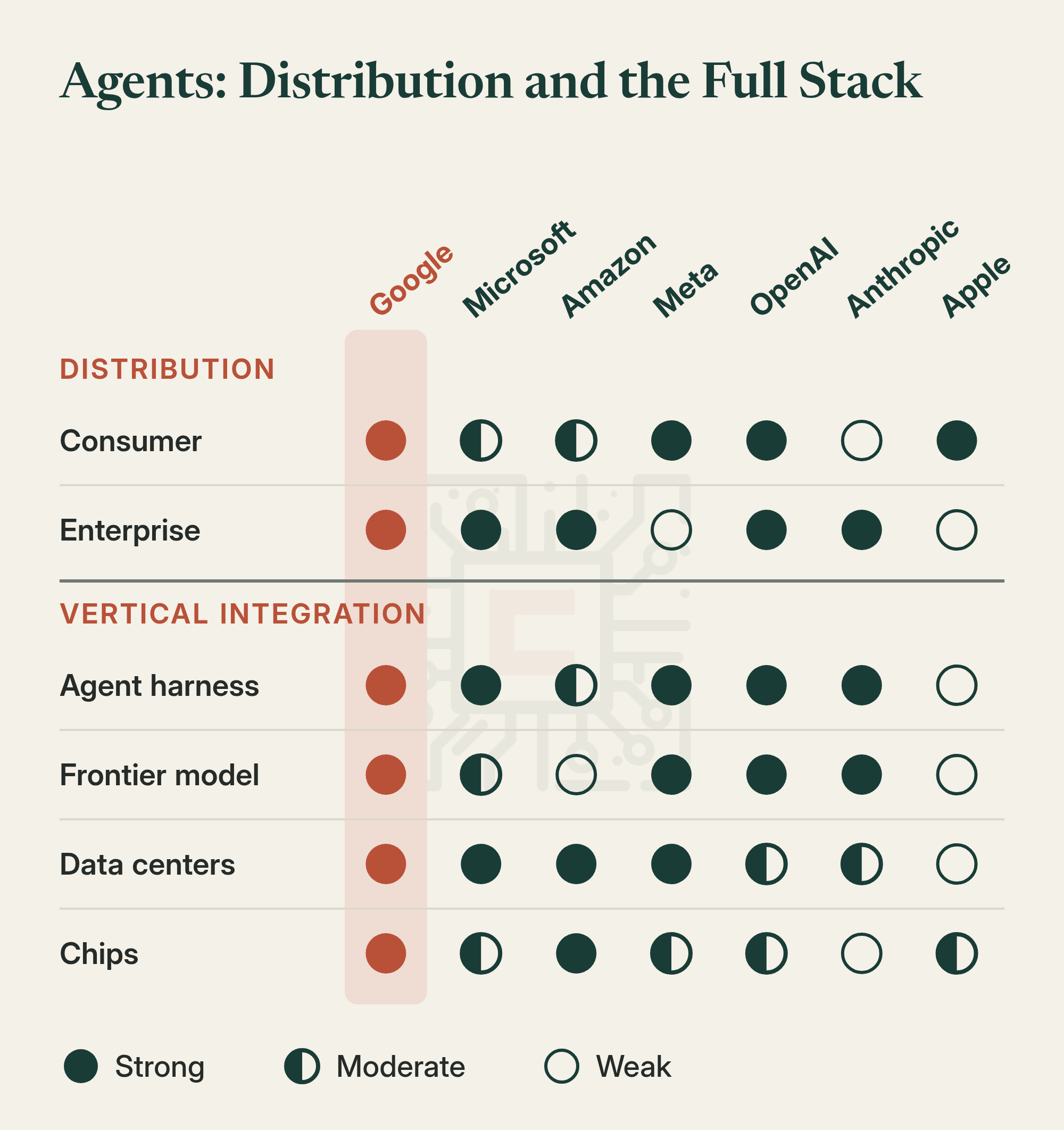
Well, you serve inference insanely efficiently. Which means vertical integration.
Frontier models and data centers are enormous fixed costs. The winners will own the full stack, so they don’t pay anyone else’s markup on accelerators, CPUs, models or data centers. And they’ll spread those fixed costs over as much paying demand as possible, which means both profitable enterprise customers and billions of ad-supported consumers.
Of course, for now when supply is so tight, we’ll see even fully vertically integrated companies continue to buy merchant silicon, rent capacity from others, etc. But long run, those who have the fullest control over costs will be well positioned.
There is one company who has solid consumer and enterprise distribution and is strong at every layer of the stack.
Google.
Let’s dig into each of these, company by company. Who stacks up as a #2 next to Google? And what does this mean for Broadcom, MediaTek, Marvell and Nvidia? Not to mention Google and Amazon who now sell their own chips?