


The first time I heard “coherent optics” I was confused; were we talking about the optics company Coherent? Or something else entirely?
If you can relate, keep reading, because I’ll explain the “small c” coherent optics.
This is another addition to our optics series, from traditional pluggable optics to LRO and LPO to NPO and CPO. If you haven’t read those, they’re quick reads, I recommend starting there.
Each of those previous articles was about links inside a data center, from a few meters up to a couple of kilometers. But what about connecting AI data centers to each other? For example, see this picture I took from Meta’s talk at OCP last week. Prometheus spreads one training cluster across buildings on a campus. The links in this slide run from 321 m to 3.8 km. Meta says the full network reaches more than 100 km once it connects other sites:
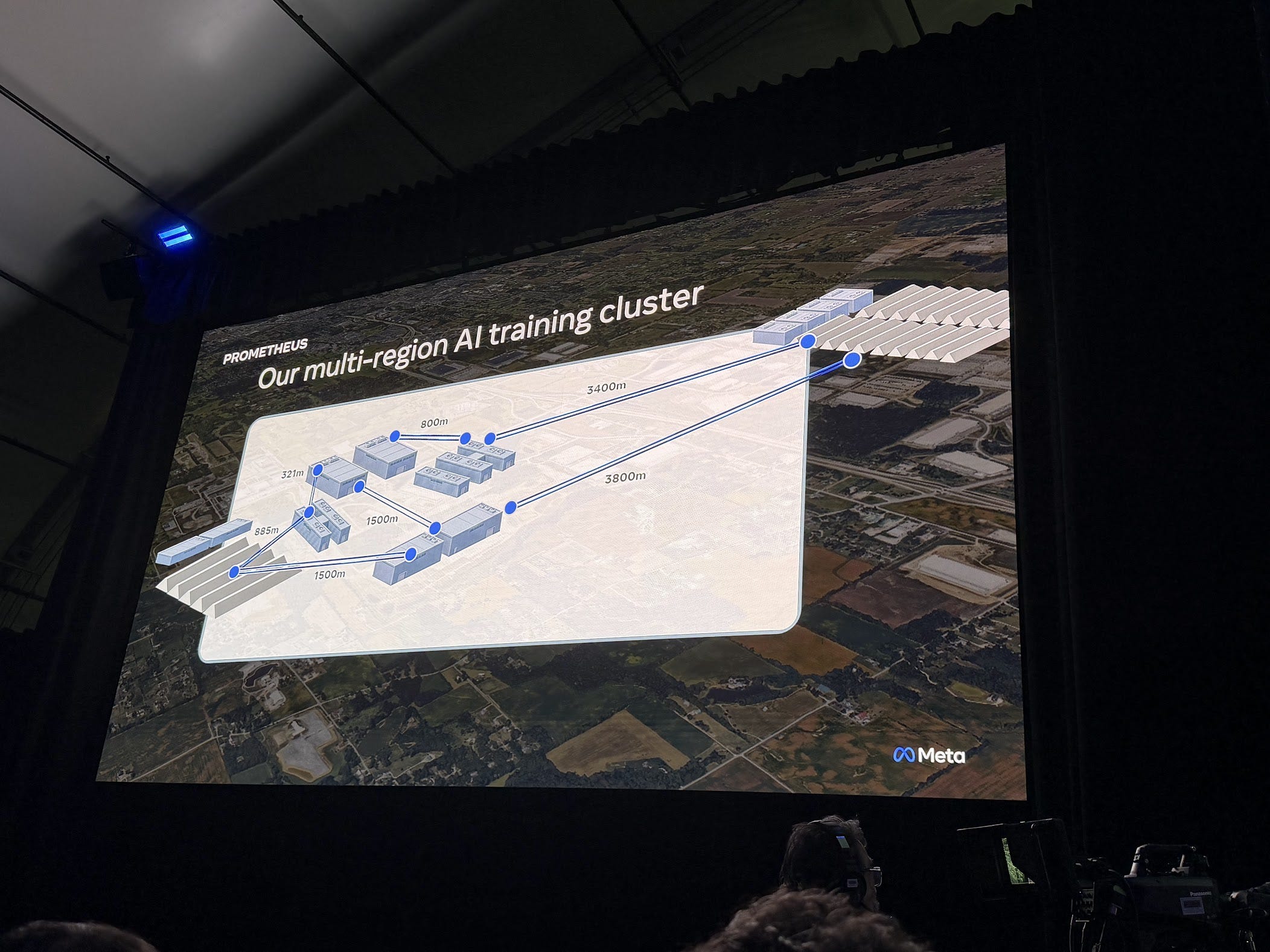
This is often referred to as “scale across”. Dell’Oro defines it as connecting the back ends of AI data centers to form larger AI training facilities.
The optics from Parts 1 to 3 (pluggables, LPO, NPO, CPO) mostly stop at 2 to 10 km. That covers links like the ones in this picture. Beyond about 10 km, Meta switches to coherent optics. Lowercase c coherent.
This article explains how coherent optics works, why it reaches so much farther, and why it costs more.
A quick recap of IM-DD
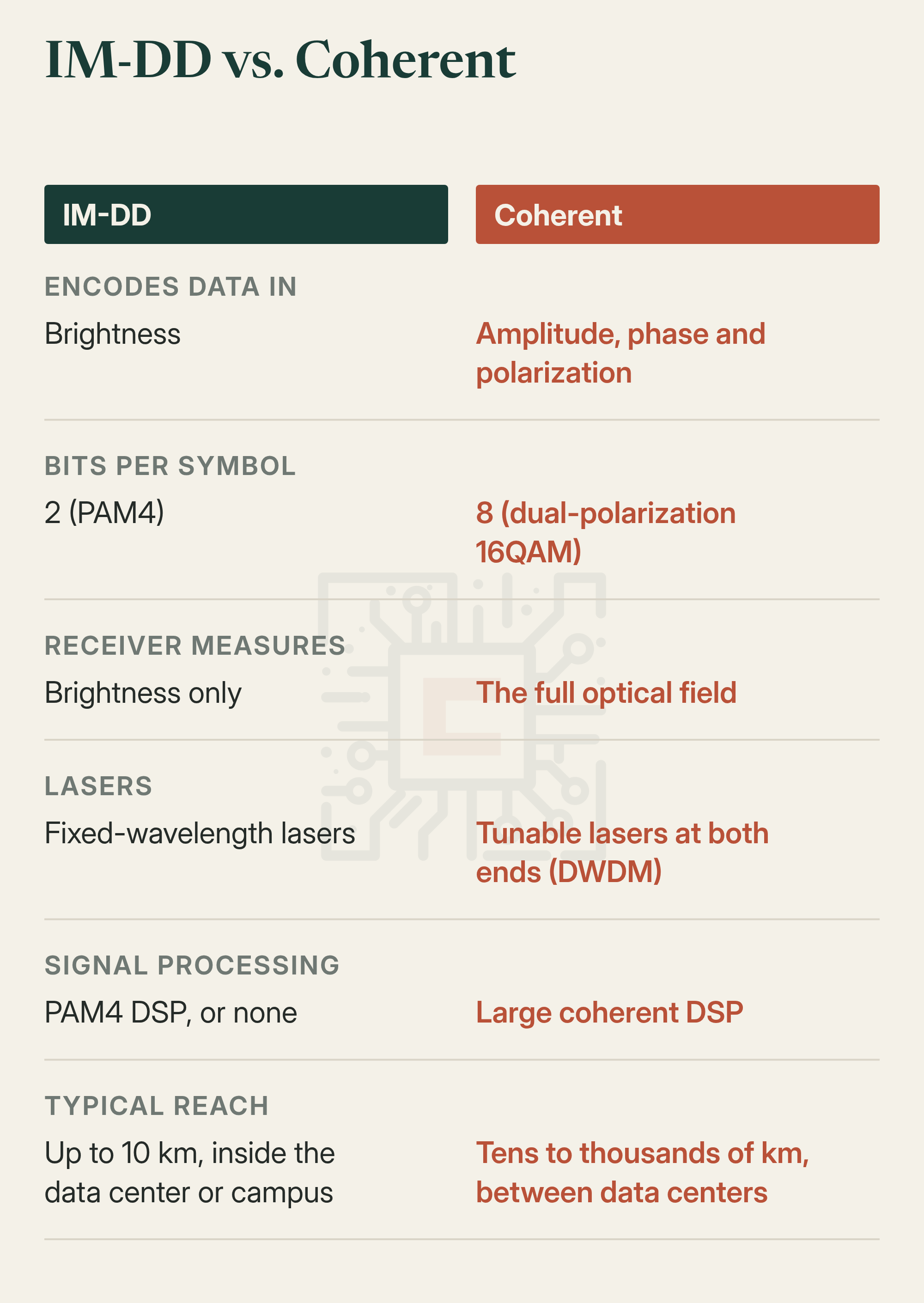
Everything we’ve discussed in Parts 1 to 3 of this series uses intensity modulation with direct detection (IM-DD). The transmitter sends data by varying the brightness of the light, either by switching the laser itself or by passing a steady laser through a separate modulator (as in EMLs and silicon photonics). At the other end, a photodiode measures that brightness and turns it into current.
The simplest version is on or off (NRZ), one bit per symbol. Today’s 400G-and-faster data center optics use PAM4 instead. PAM4 has four brightness levels, so each symbol carries 2 bits.
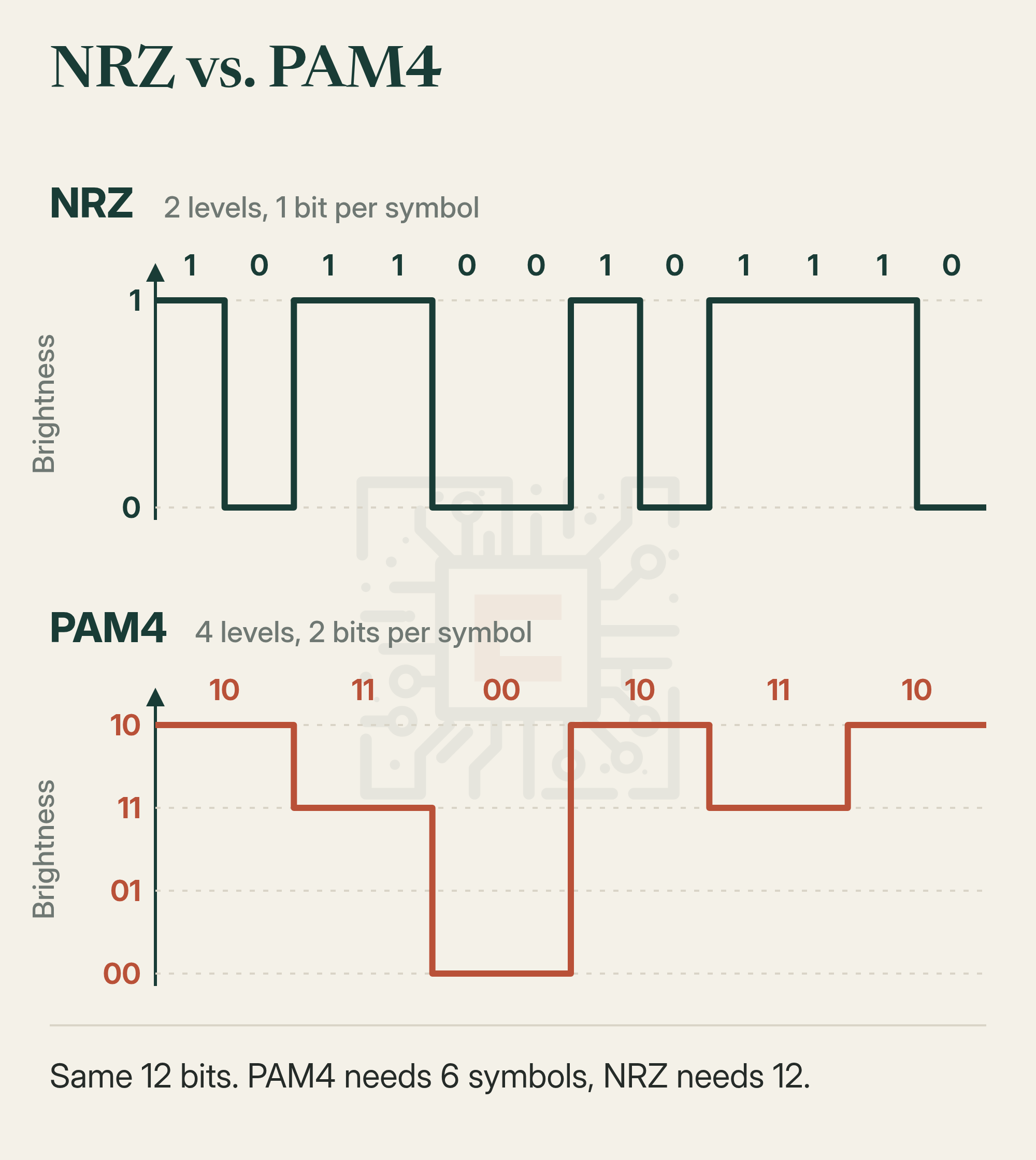
IM-DD is cheap and low power. But brightness is all the photodiode sees. A light wave also has a phase and a polarization, but IM-DD doesn’t take advantage of that information.
What are phase and polarization? Light is a wave. Its electric field oscillates as it travels, and that wave has three properties you can use to carry data.
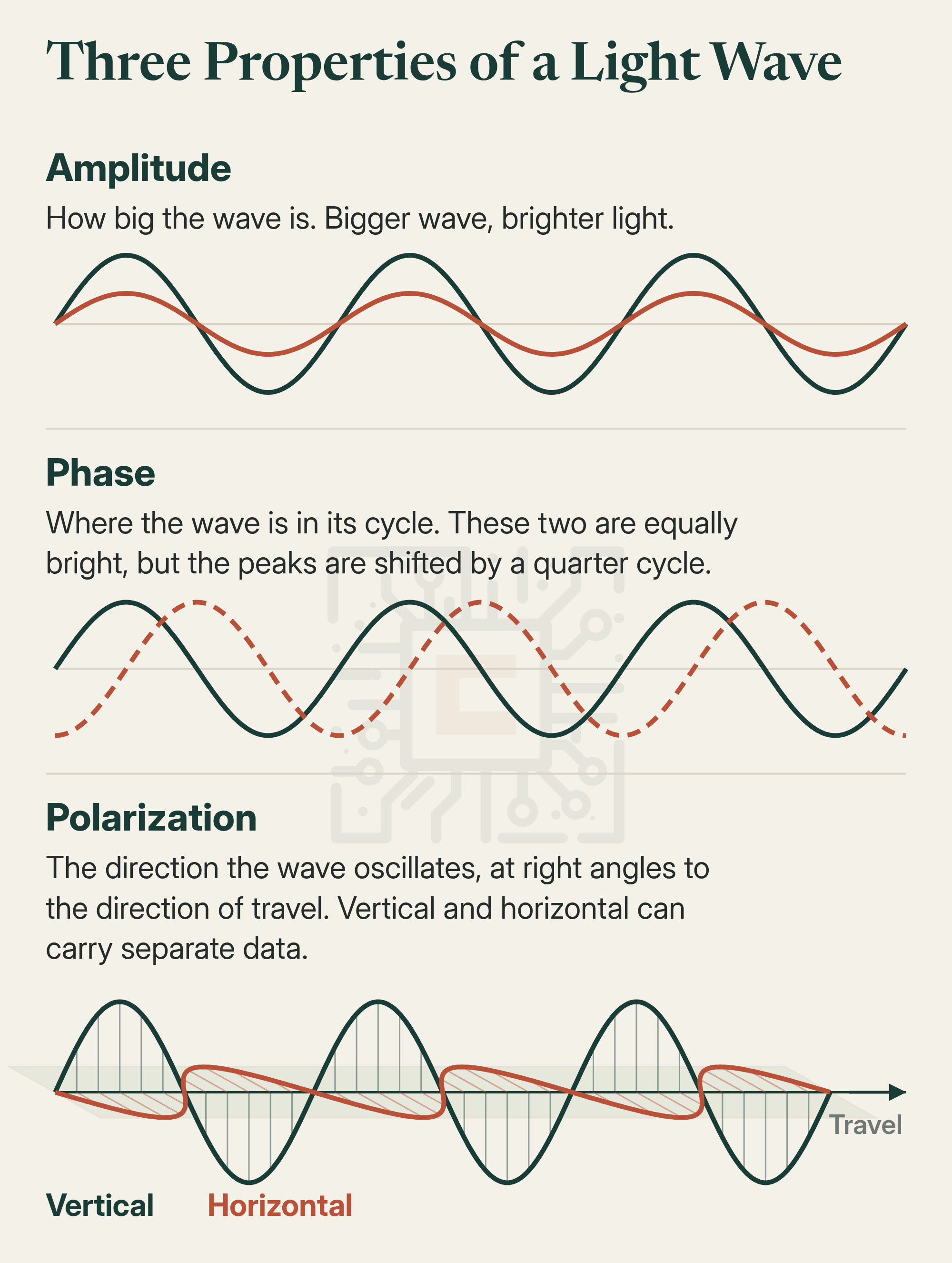
A photodiode doesn’t see the wave swing up and down. Light hitting it frees electrons in proportion to how much power arrives, aka brightness. (The fastest photodiodes respond at around 100 GHz. Light at 1550 nm oscillates at about 193 THz, roughly 2,000 times faster.) Two waves with the same amplitude but different phase or polarization look identical to the photodiode.
Inside a data center, that’s fine. Over longer distances, fiber causes two problems.
First, dispersion. Vik talked about this on our podcast this week, see around 16:30.

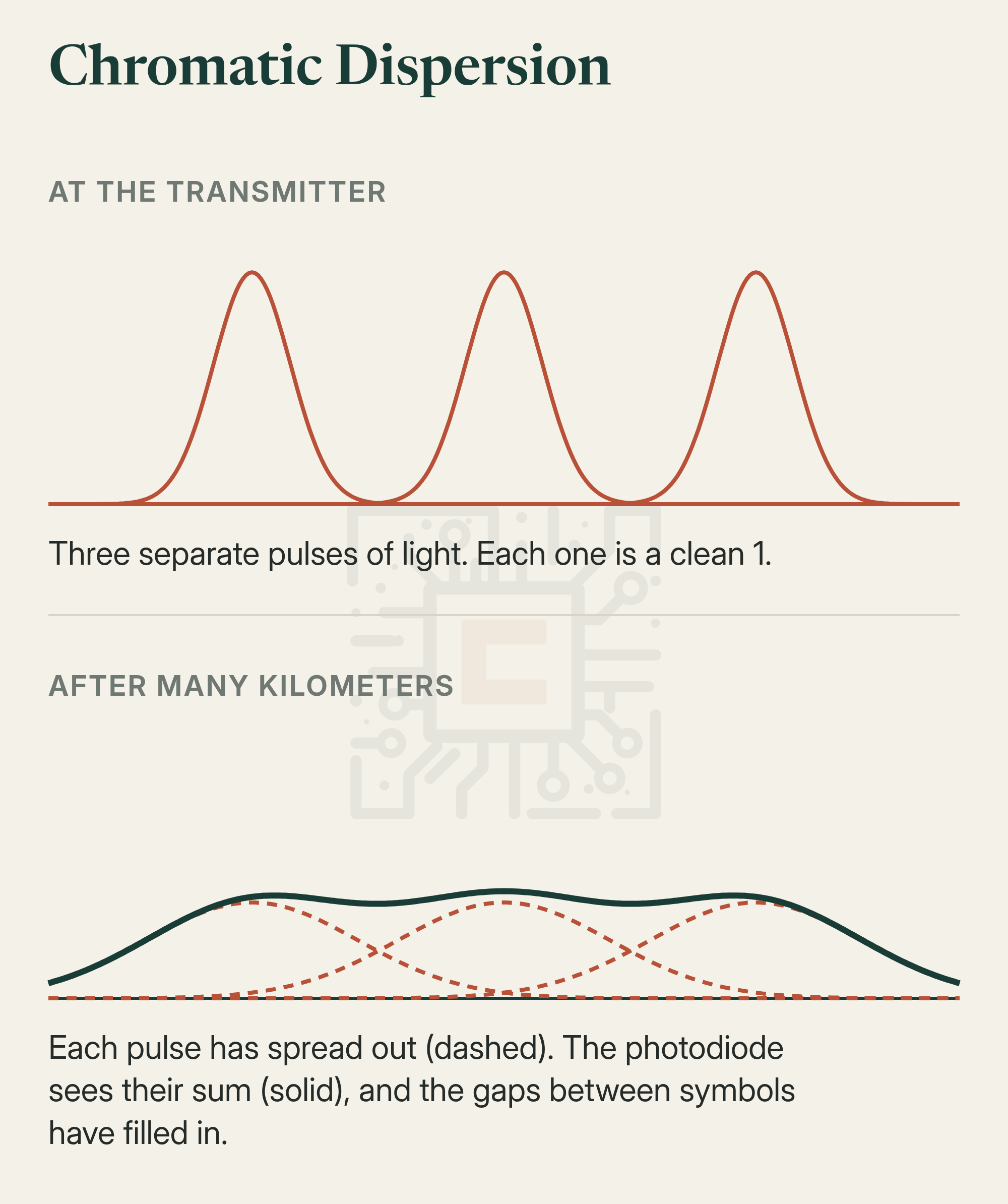
With chromatic dispersion, the different wavelengths in a pulse travel at slightly different speeds, so over many kilometers each pulse smears into its neighbors. The wider the signal’s spectrum, the worse the smearing. That spectrum comes from the laser’s linewidth and from the modulation itself, so faster symbol rates smear more. Vik explains the linewidth side in MicroLEDs vs. Lasers: The Linewidth Tradeoff.
Second, loss.
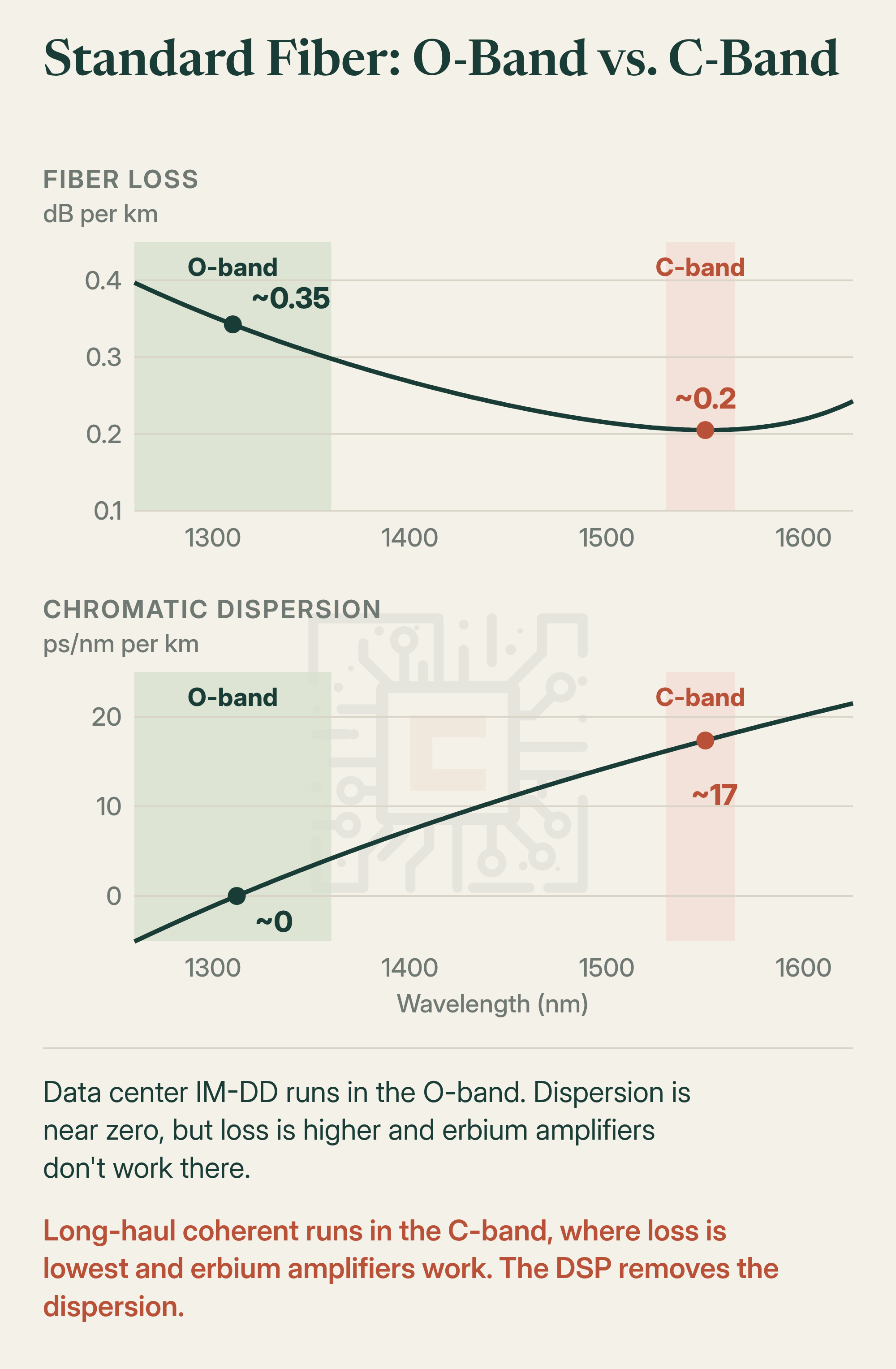
Fiber also loses light, mostly to scattering in the glass and partly to absorption. Standard single-mode fiber loses about 0.35 dB/km near 1310 nm and about 0.2 dB/km near 1550 nm.
(Quick dB refresher: decibels are logarithmic. Every 3 dB roughly halves the power, and every 10 dB reduces it to a tenth. So 100 km of fiber at 0.2 dB per km is 20 dB of loss, and only 1% of the light makes it out the other end. Engineers use dB because it turns multiplying into adding. Each kilometer passes along a fraction of the light, and over a long run those fractions multiply. In dB you just add up the losses, and add back any amplifier gain.)
That sets up a trade-off. The industry splits fiber wavelengths into bands. Data center optics run in the O-band (“original”, 1260 to 1360 nm), where standard fiber has near-zero chromatic dispersion (zero at about 1310 nm). But loss is higher there.
The C-band (“conventional”, 1530 to 1565 nm) has the lowest loss, and it’s where erbium-doped fiber amplifiers (EDFAs) work (they also cover the neighboring L-band). An EDFA is a short stretch of fiber doped with erbium and pumped by a laser. It boosts every C-band wavelength passing through it at once, without converting anything to electrical. That’s what makes long routes affordable; without EDFAs, you’d have to convert each wavelength back to electrical and regenerate it every 80 to 100 km.
But dispersion in the C-band is about 17 ps/nm per km. A direct-detection receiver can’t fully undo that, because it has already thrown away the phase.
So most data center IM-DD optics reach 500 m (DR), 2 km (FR) or 10 km (LR). A few variants stretch to 40 km (ER).
Those letters come from the industry’s reach classes. Vik has a great chart of the whole ladder, from VSR inside a rack to ZR and ZR+ over hundreds of kilometers. This is from behind Vik’s paywall. I asked him for permission. He has lots of goodies back there :)
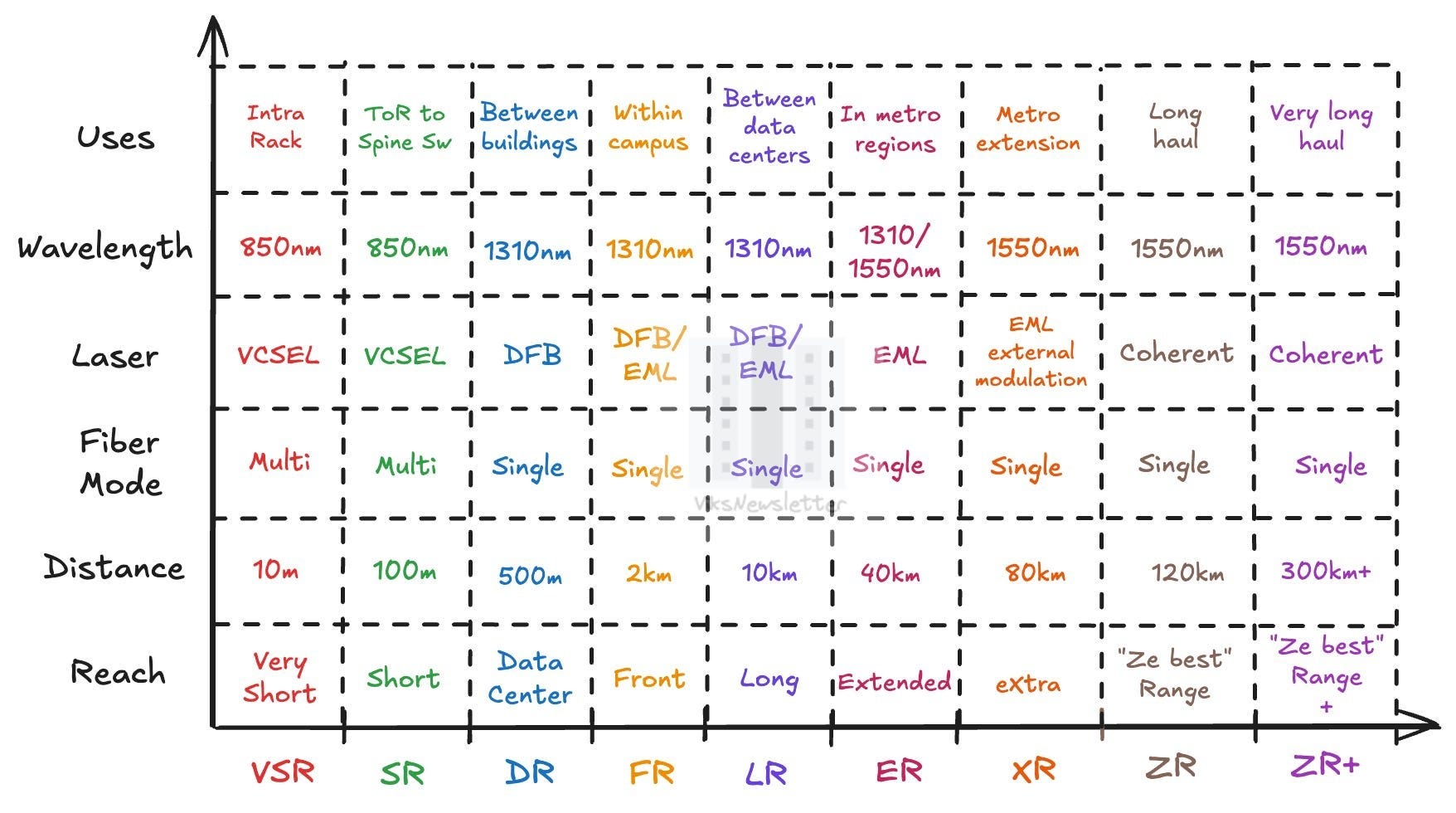
Look at the laser row. Everything up to ER is a VCSEL, DFB or EML using IM-DD. Today, at ZR and beyond, it’s coherent.
Coherent runs in the C-band so it can use those amplifiers, and its DSP removes the dispersion.
What coherent adds
Coherent optics encode data in amplitude, phase and polarization.
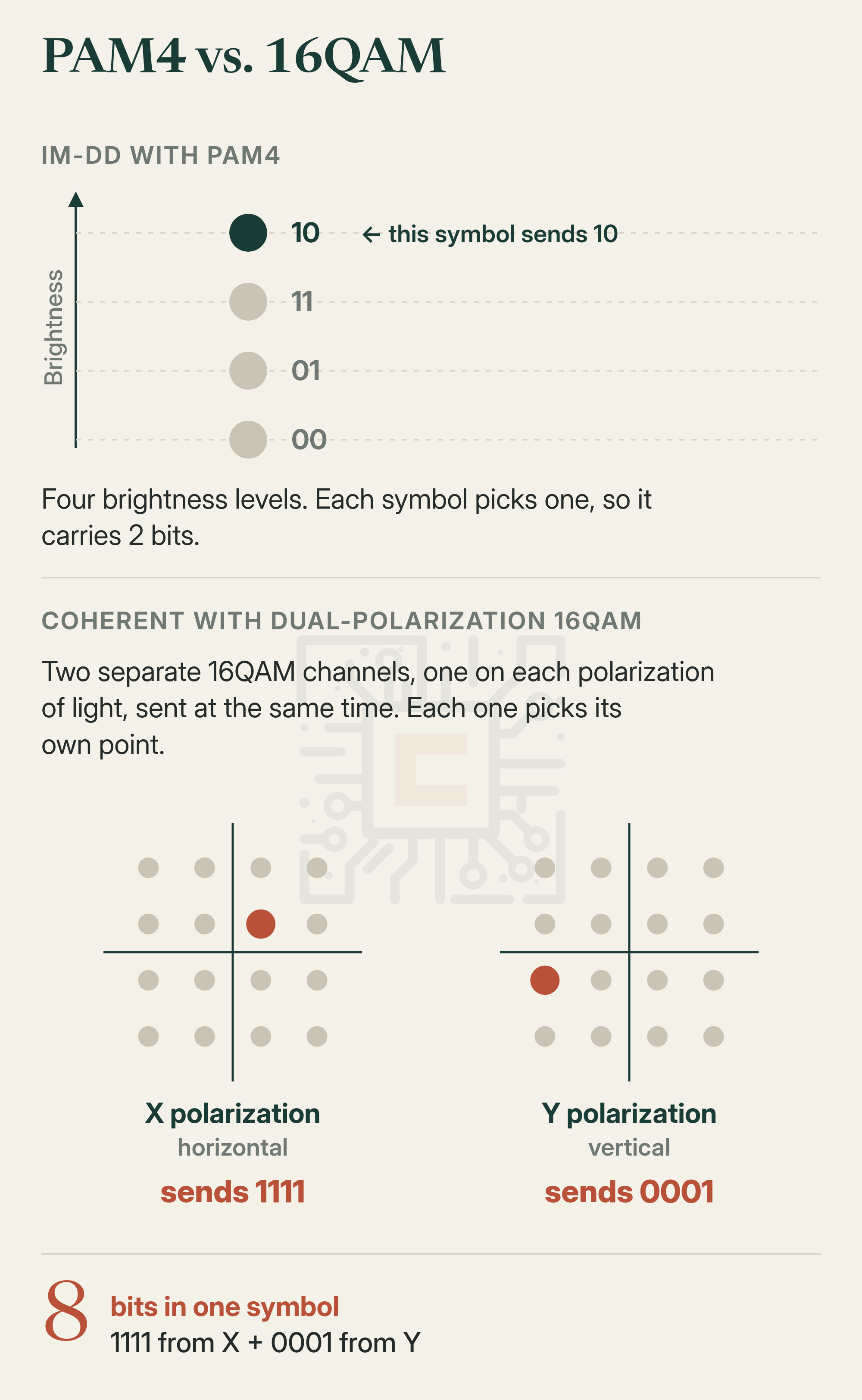
The common format is dual-polarization 16QAM. QAM stands for quadrature amplitude modulation, and the 16 is the number of points. “Quadrature” means a quarter cycle (90°) apart.
QAM builds each symbol from two copies of the same wave, offset by a quarter cycle, and sets how strong each one is and whether it’s flipped. The reference copy is called in-phase (I) and the shifted copy is called quadrature (Q).
Those are the two axes on the chart. 16QAM has 16 points, each a different combination of amplitude and phase, so each symbol carries 4 bits. Coherent systems then send separate data on two polarizations of light (X and Y), which doubles it to 8 bits per symbol.
That’s 4x the bits per symbol of PAM4. You can use that to move 4x the data at the same symbol rate, or the same data with slower electronics.
Packing more bits into each symbol puts the points closer together, so the receiver needs a cleaner signal to tell them apart. Vik walks through the same trade-off for copper in The PAM4 vs PAM6 Dilemma for 448G Copper Interconnects.
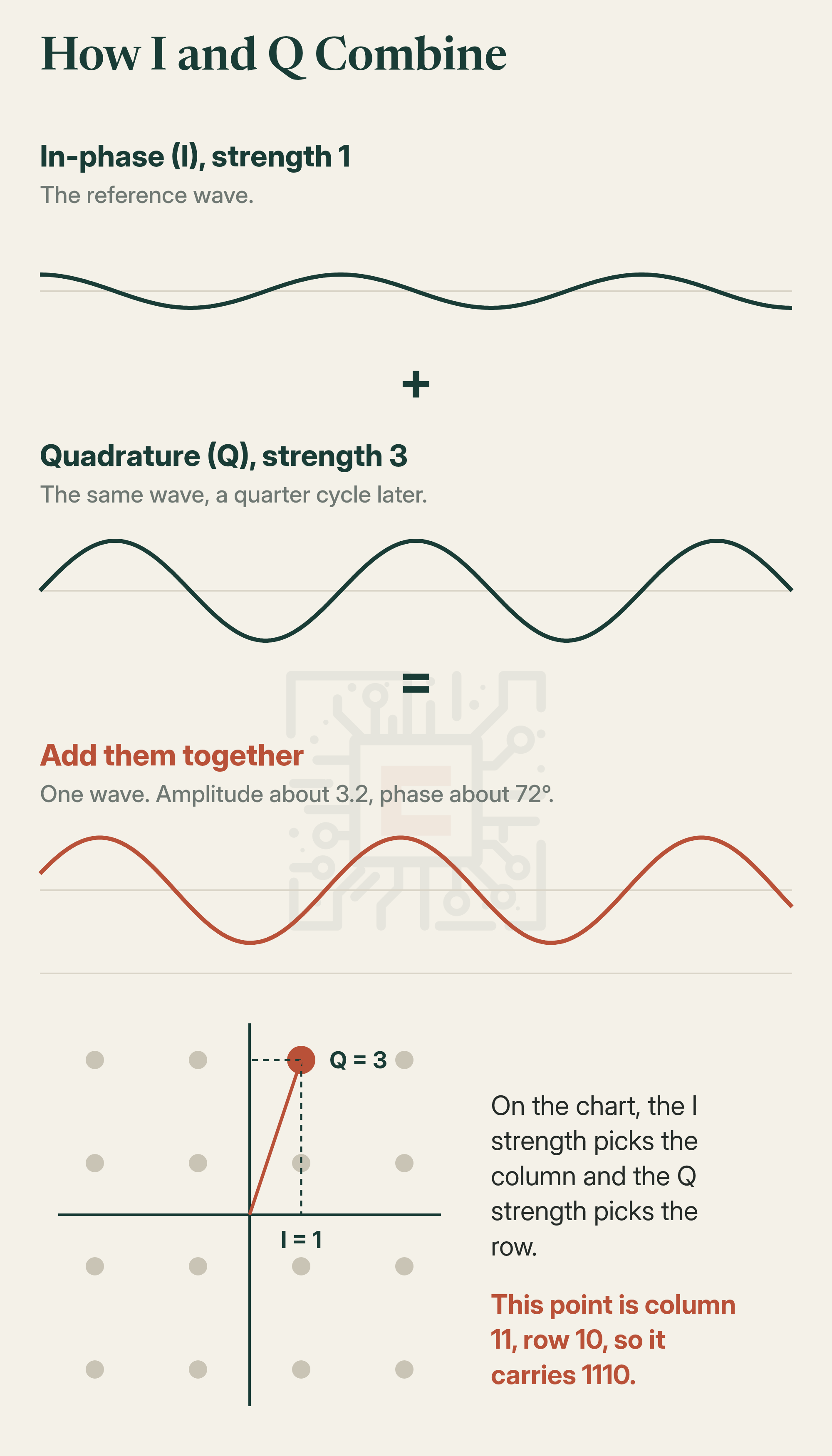
What does one of those 16 points look like as light? Each point is a specific wave. Its distance from the center sets the amplitude, and its angle sets the phase. Here are three of them.
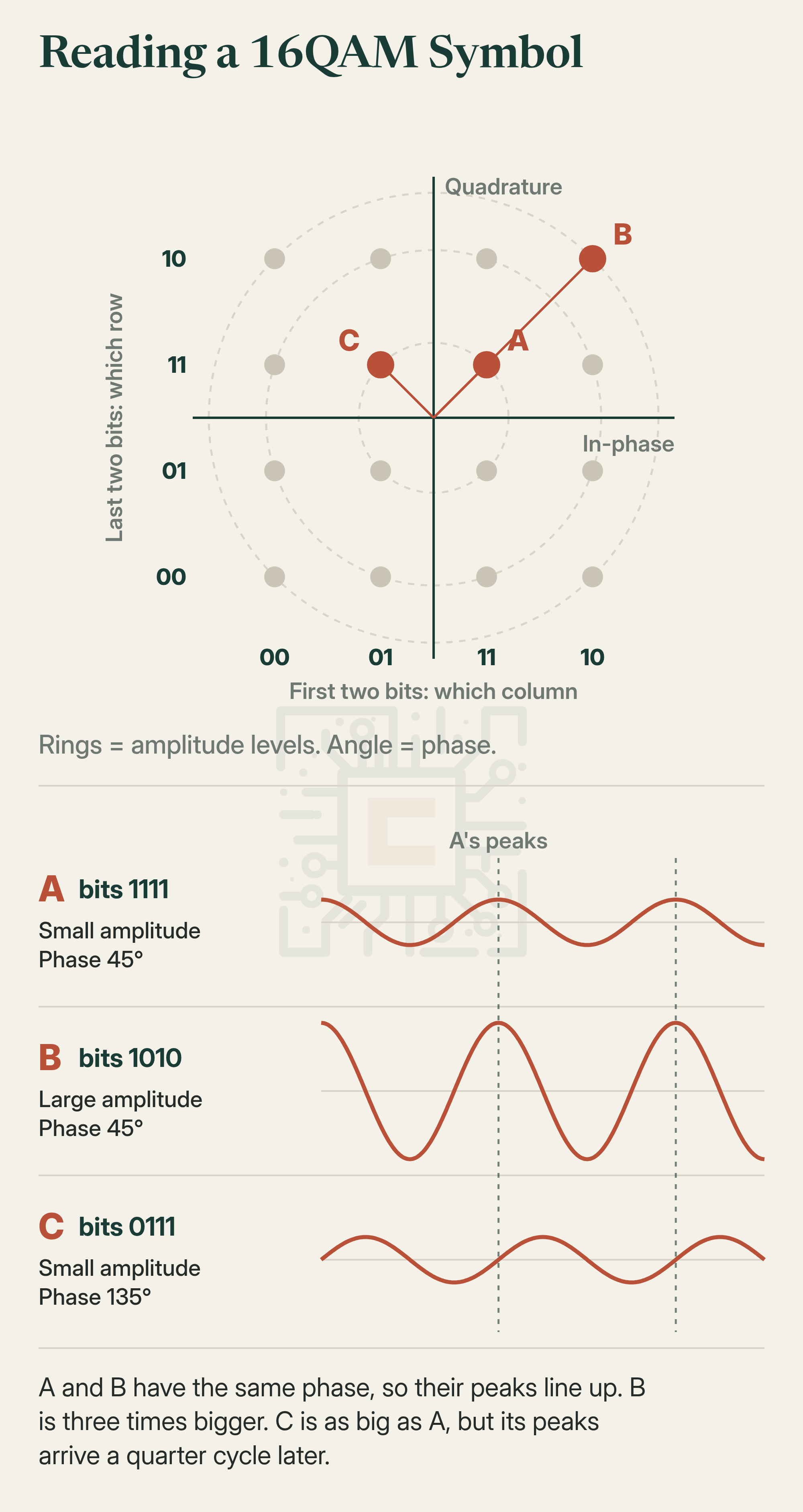
Where do the bits come from?
16QAM is really two PAM4 signals at once, one on the in-phase axis and one on the quadrature axis. Each axis has four levels. The first two bits pick the column, and the last two pick the row. B sits in column 10 and row 10, so it carries 1010.
The levels are labeled 00, 01, 11, 10 rather than counting up in binary. That’s Gray coding. I vaguely remember this from undergrad.
Neighboring points differ by only one bit, so if noise nudges a symbol into its neighbor, only one bit comes out wrong.
How the receiver measures phase
A photodiode can’t measure phase. It only responds to brightness. So how do you measure phase, then?
So a coherent receiver carries its own laser, called the local oscillator, tuned to nearly the same wavelength as the incoming signal. An optical component called a 90° hybrid mixes the two. The mixing turns phase differences into brightness differences, which photodiodes can measure.
How?
When two light waves of the same wavelength overlap, they add. If their peaks line up, they reinforce each other and the light gets brighter. If one’s peak meets the other’s trough, they cancel and the light goes dark. Anything in between gives something in between. So the brightness of the mixed light depends on the signal’s phase relative to the local oscillator.
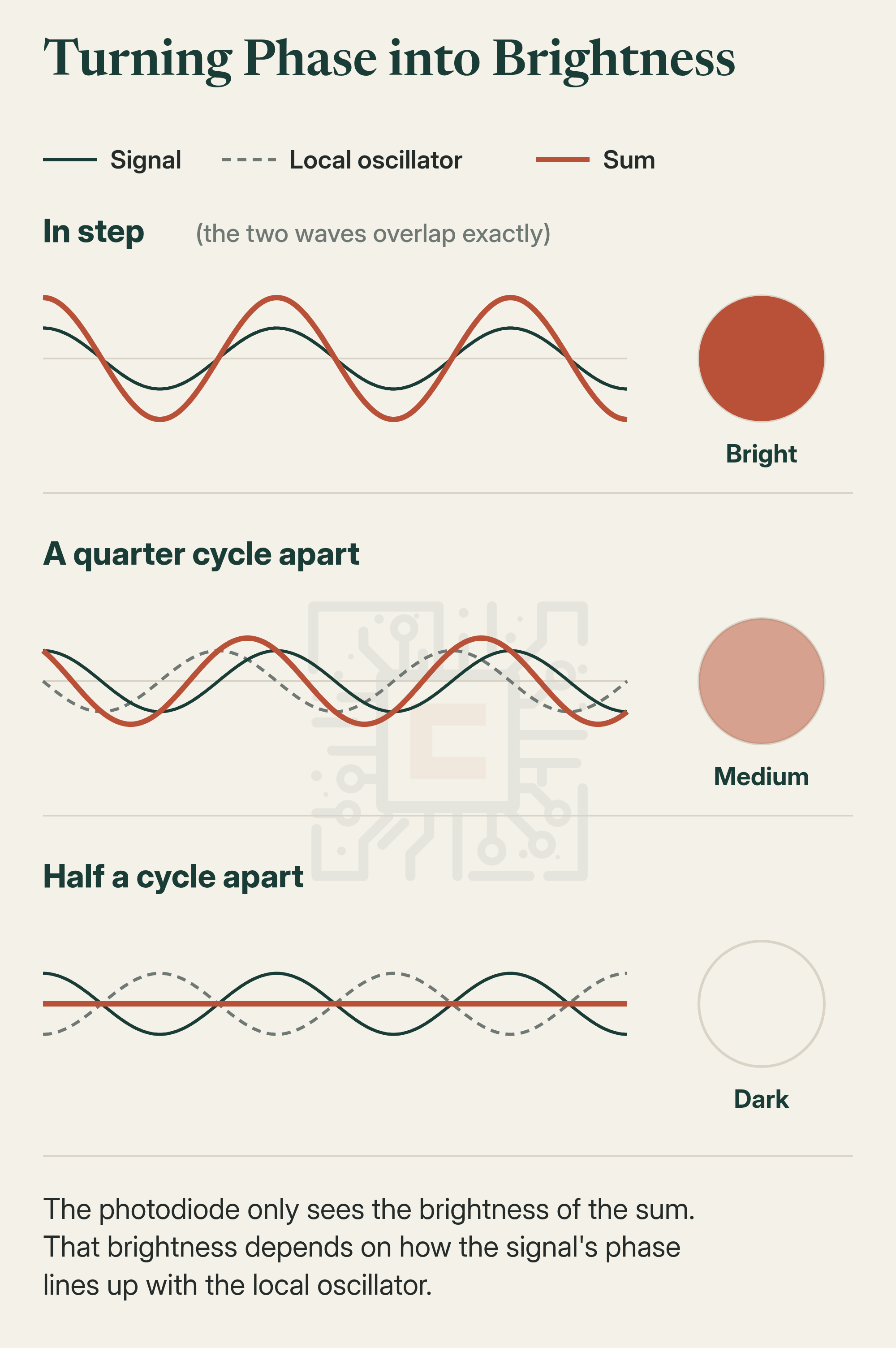
One comparison isn’t enough, since phases of +45° and −45° come out equally bright. So the 90° hybrid mixes the signal with the local oscillator four ways, shifted by 0°, 90°, 180° and 270°. The 0° and 180° outputs give I, and the 90° and 270° outputs give Q. Together they pin down both amplitude and phase.
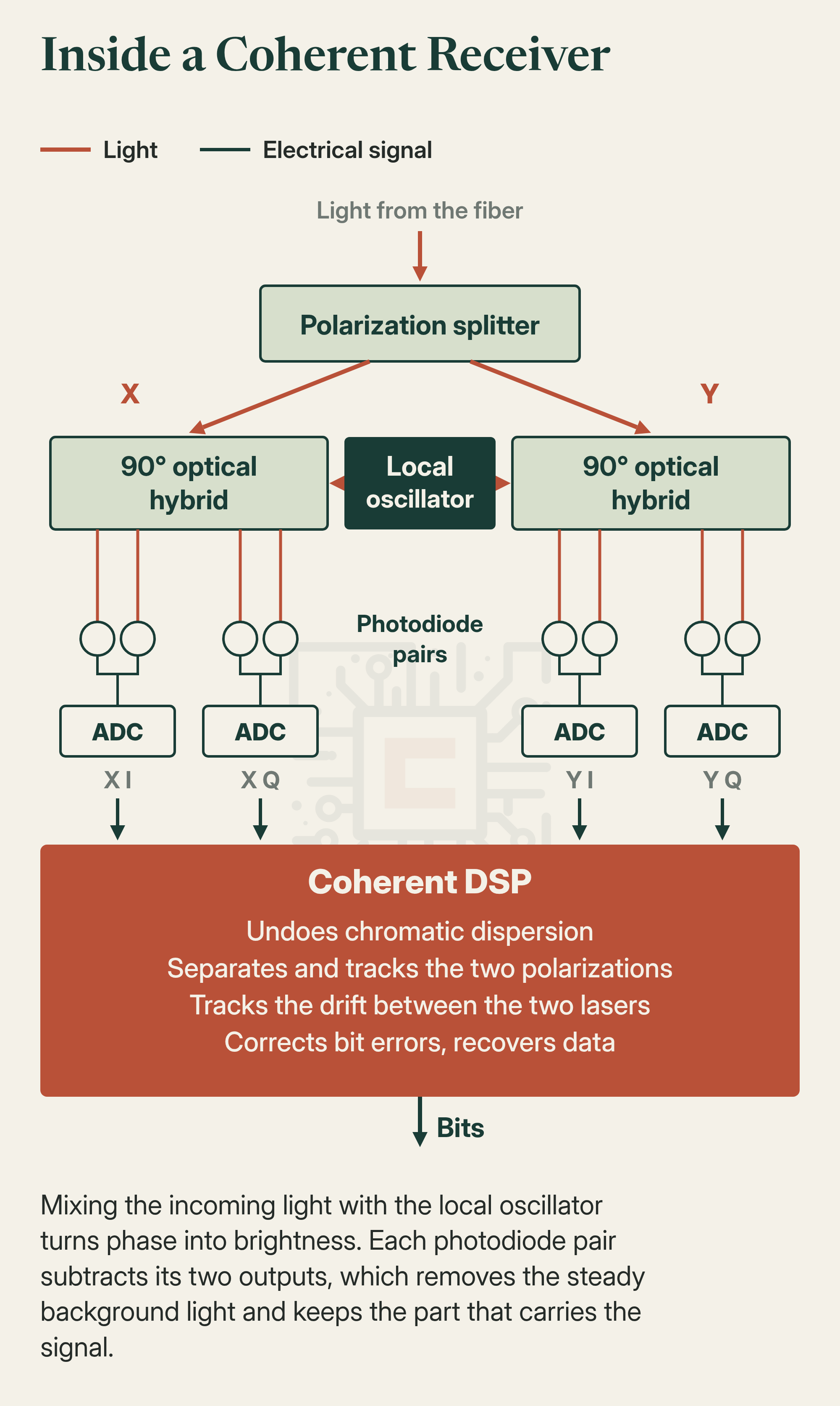
Each hybrid sends its light to two pairs of photodiodes, eight in all. Each pair reads the difference between its two photodiodes (this is called balanced detection). The steady light from the local oscillator, and its noise, hits both photodiodes equally and cancels, while the part that depends on the signal’s phase adds up. So the receiver ends up with four electrical signals. In-phase and quadrature for X, and the same for Y. ADCs digitize them, and a DSP takes over.
Why go to all this trouble? You get three things.
First, sensitivity.
The local laser is strong, and mixing it with a weak incoming signal lifts that signal above the receiver’s electrical noise. So a coherent receiver can pick up much fainter light than a plain photodiode, which leaves more room for fiber loss.
Second, the DSP fixes the fiber.
Because the DSP sees amplitude and phase in both polarizations, it can undo chromatic dispersion and polarization drift with math. Long-haul networks used to need actual spools of dispersion-compensating fiber to do that optically. The DSP also keeps tracking the drift between the transmit laser and the local oscillator. They’re two separate lasers, and they’re never perfectly in step. (That’s one reason coherent needs lasers with a narrow linewidth. More on lasers below.)
Lastly, channel density.
Only light near the local oscillator’s wavelength produces a signal slow enough for the photodiodes and ADCs to pick up. Everything else is effectively ignored. So you can pack lots of wavelengths close together on the same fiber.
This is dense wavelength division multiplexing (DWDM).
Multiplexing just means combining many signals onto one shared channel. “Wavelength division” means each signal gets its own wavelength (i.e. color) of light, and “dense” means those wavelengths sit close together. A mux (multiplexer) combines them onto one fiber at the sending end. A demux (demultiplexer) splits them back apart at the receiving end, roughly the way a prism splits white light into colors. (IM-DD can do DWDM too, but coherent fits more data into each slice of spectrum.)
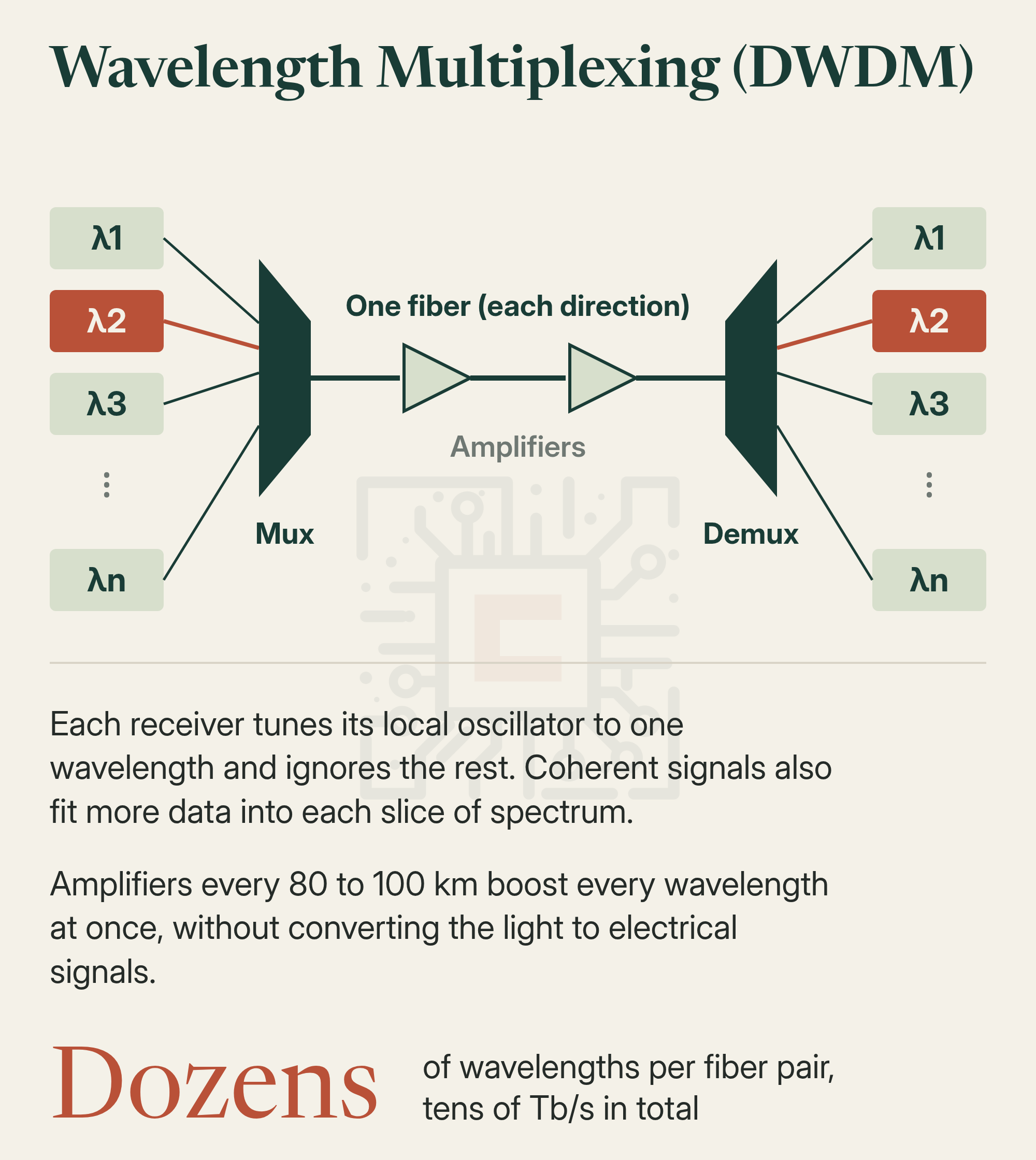
One fiber pair can carry dozens of wavelengths and tens of Tb/s in total. Along the route, optical amplifiers boost every wavelength at once, roughly every 80 to 100 km, without converting anything to electrical.
That’s why hyperscalers pay for coherent. Over hundreds of kilometers, the fiber is the expensive part. Trenching, rights-of-way, and permits cost far more than the optics at each end. Coherent gets the most data out of fiber you already own or lease. Ciena’s WaveLogic 6 Extreme carries 1.6 Tb/s on a single wavelength.
Why it isn’t used everywhere
This is expensive.
A coherent link needs a tunable laser at both ends (the transmitter plus the local oscillator) and a large DSP. That means more power, more cost and more latency than PAM4.
How much more?
A 2022 IEEE working-group contribution from Source Photonics and SiFotonics, which argued for IM-DD at 10 km, estimated that, compared with a 400G LR4 IM-DD module (10 km), a 400ZR coherent module’s DSP costs about 10x as much, its lasers about 15x, and its receiver about 20x. Power roughly doubles, from about 8 W to 15 to 20 W.
Ouch.
Inside a data center you have hundreds of thousands of links, almost all under 2 km. IM-DD wins there easily.
What’s it made of?
Is it all indium phosphide (InP)?
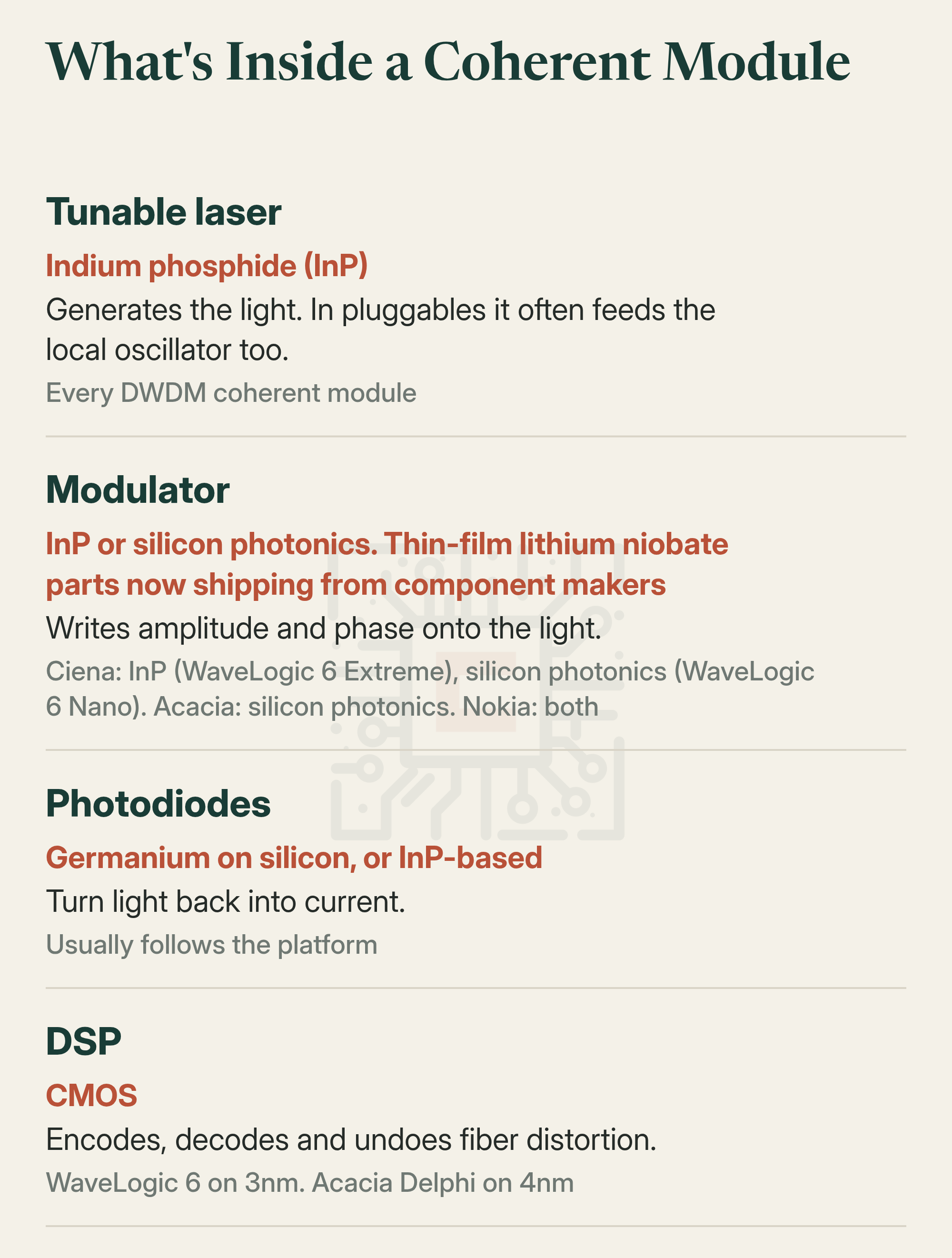
The laser is. The rest is a mix.
Start with the laser.
Every coherent module for DWDM needs a tunable laser, and those are built on InP. Why not silicon? Silicon can’t lase efficiently because of its indirect bandgap (Vik explains in Why We Can’t Build Lasers on Silicon). And coherent asks more of the laser than IM-DD does. The data rides on phase, so the laser’s own phase has to stay really stable, i.e. a narrow linewidth. Vik’s Lasers for CPO/NPO, Part 1 covers how InP lasers control wavelength and linewidth. In a pluggable, one tunable laser often does double duty, split between the transmitter and the receiver’s local oscillator.
Coherent optics asks more of the laser than IM-DD does.
The data rides on phase, so the laser’s own phase has to stay very stable (i.e. a narrow linewidth). Vik’s Lasers for CPO/NPO, Part 1 covers how InP lasers control wavelength and linewidth. In a pluggable, one tunable laser often does double duty, split between the transmitter and the receiver’s local oscillator.
IM-DD optics use InP too, by the way.
Either as directly modulated lasers, as EMLs (Lumentum and the Laser Bottleneck), or as continuous-wave lasers feeding a silicon photonics modulator. The exception is short multimode links, which use gallium arsenide VCSELs (VCSELs + 200G Wall In AI Datacenters?).
The modulator is where vendors split up.
Ciena uses an InP modulator in WaveLogic 6 Extreme and a silicon photonics modulator in WaveLogic 6 Nano.
Acacia (now Cisco) went with silicon photonics early. In 2014 it introduced the first single-chip silicon photonics 100G coherent transceiver and shipped the first pluggable 100G coherent module.
Nokia, through Infinera, runs an InP fab in Sunnyvale that puts tunable lasers, amplifiers, modulators and detectors on a single chip. Nokia’s own pre-Infinera optics use silicon photonics, so it now has both. (For more on monolithic InP integration versus bonding lasers onto silicon, see Vik’s interview with Prof. Martijn Heck.)
Then there's lithium niobate, the old-school option. Bulk lithium niobate modulators were the long-haul standard for years, and suppliers still sell them for slower 32 to 64 GBaud designs. The thin-film version (TFLN) handles today’s higher symbol rates. Advanced Fiber Resources and Furukawa FITEL (the former Fujitsu Optical Components) now sell TFLN coherent modulators, and Sumitomo Osaka Cement is sampling one. AFR says it ships them in volume to unnamed tier-1 customers. Ciena, Acacia and Nokia haven’t said whether any shipping product uses TFLN.
Photodiodes usually follow the platform. Silicon photonics chips use germanium photodiodes, and InP chips use InP-based detectors.
And the DSP is plain CMOS on leading-edge nodes. Ciena says WaveLogic 6 was the first coherent DSP built on 3nm. Acacia’s Delphi is on 4nm.
Boxes and pluggables
Coherent ships in two forms.
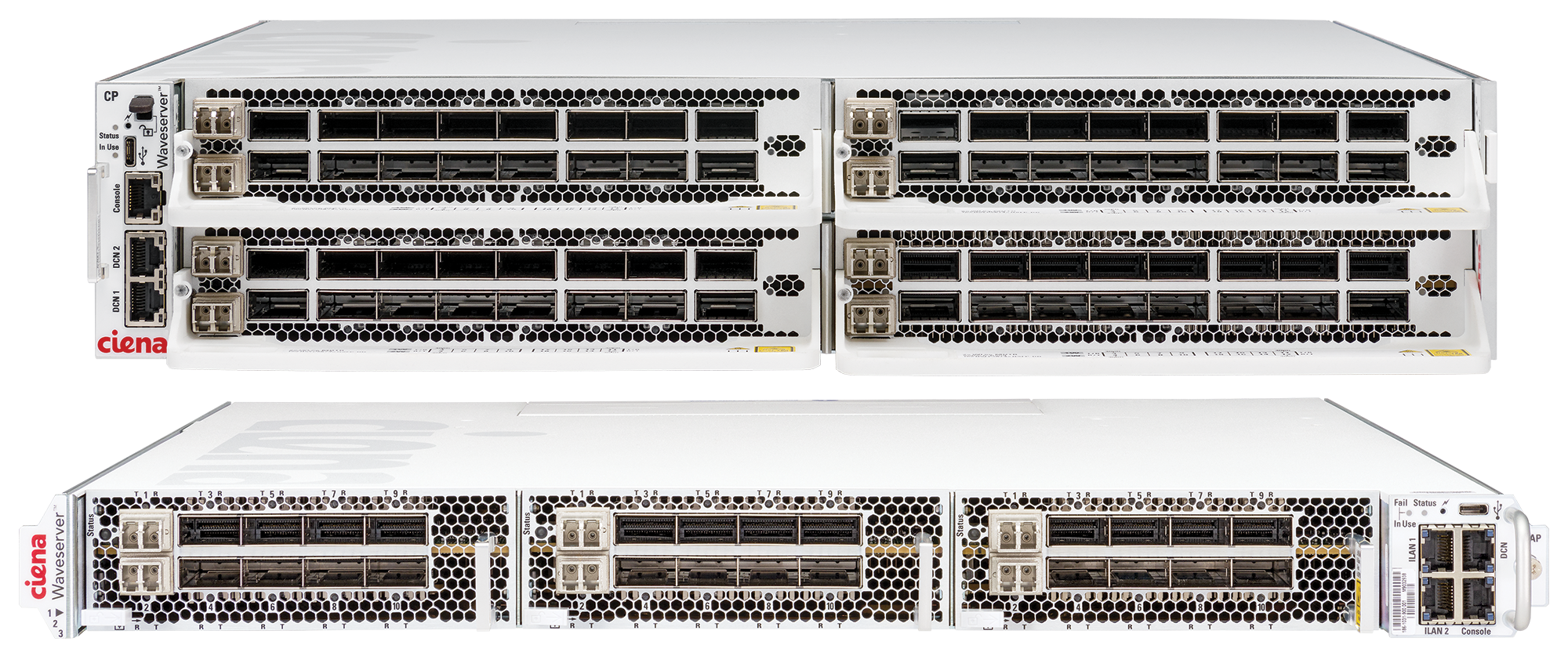
The first is an embedded modem in a transponder box. Ciena’s Waveserver is an example. It takes Ethernet from a router and puts it on the fiber as coherent wavelengths. This is where the highest-performance DSPs go, like WaveLogic 6 Extreme at 1.6 Tb/s per wavelength.
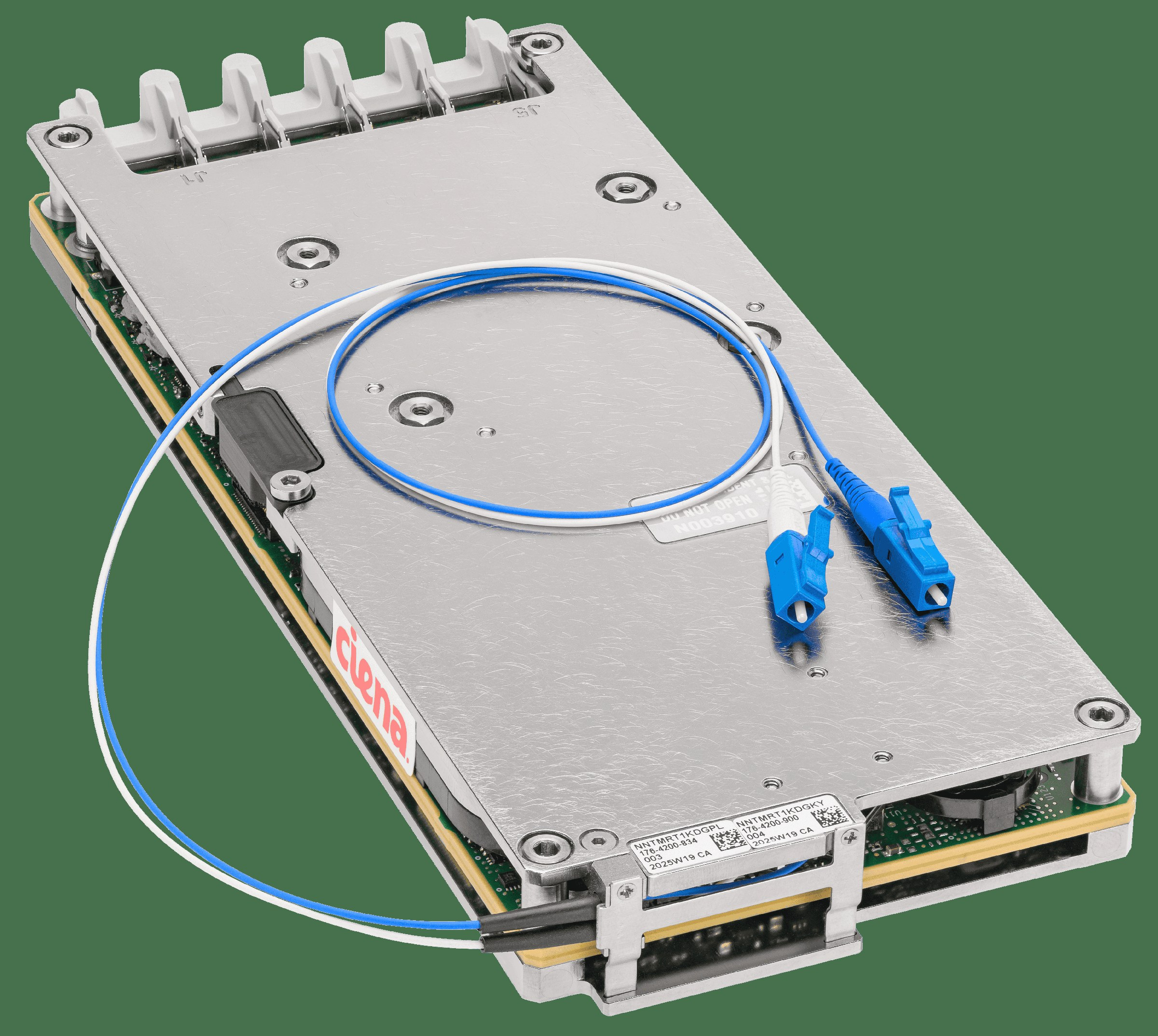
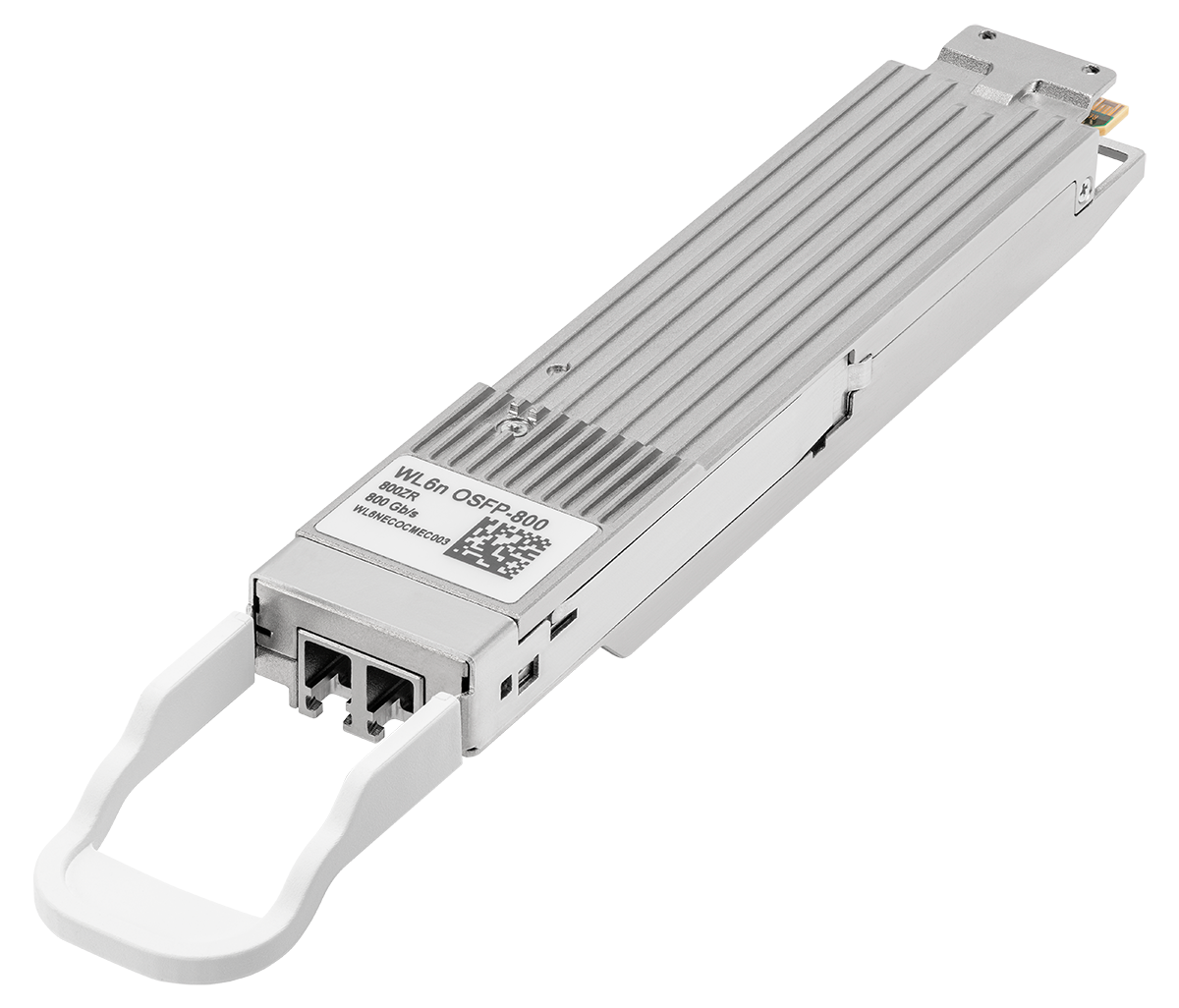
The second is a coherent pluggable. T
he DSP and a tunable laser are squeezed into a module that plugs straight into a router port, no transponder box needed. The OIF 400ZR implementation agreement carries 400G over roughly 80 to 120 km of amplified fiber. 800ZR does the same at 800G. ZR+ variants, defined by the OpenZR+ MSA and OpenROADM rather than the OIF, add stronger error correction and higher output power to reach hundreds of kilometers or more.
Pluggables are taking over.
Cignal AI titled its January report “Coherent Optics: It’s a Pluggable World”, and it expects embedded modems to end up limited to subsea and ultra-long-haul routes. Cignal estimates coherent pluggable revenue at about $2B in 2025, growing to $7.5B by 2030. 800ZR+ alone goes from about $100M in 2025 to nearly $1B in 2026, with Meta as the first big buyer.
Dell’Oro expects scale-across to drive much of that growth and shift the market toward ZR+ modules.
Coherent-lite
Can coherent move inside the campus?
That’s the idea behind coherent-lite. It’s coherent stripped down for links of a few kilometers, the territory IM-DD has always owned. The OIF 800LR spec uses a single fixed wavelength over up to 10 km with no amplifiers. It defines an O-band version near 1311 nm and a C-band version. In the O-band, dispersion is near zero, so the DSP does less work. In both, a fixed laser replaces the tunable one. It has three advantages inside a campus.
Reach. AI clusters now span several buildings, like Meta’s Prometheus. Ciena’s coherent-lite reaches 20 km. Data center IM-DD mostly stops at 10 km.
Fewer fibers. With WDM, one fiber pair carries up to 6.4 Tb/s in the O-band, by Ciena’s figures, so a campus needs fewer strands between buildings.
More loss budget. Optical circuit switches add loss to every link they route. Ciena says coherent-lite tolerates more than 4 dB of extra loss compared with IM-DD in those fabrics.
The potential volumes are much bigger. 650 Group expects the coherent-lite market to pass 10 million units within three to five years. For scale, Cignal AI expects a bit over 200,000 800ZR and 800ZR+ modules to ship in 2026, and it has written that coherent-lite could reach 10x the module volume of DCI.
Ciena’s 1.6T coherent-lite pluggable is an example. It targets 2 km for data center fabric and 20 km for a campus. Ciena says its power consumption is “comparable” to IM-DD, but doesn’t publish a figure in watts or picojoules per bit.
Not everyone is convinced the timing is now. Cignal AI wrote in July that several customers have shown interest at 800G and 1.6T but none have placed volume orders. At 800G, 200G-per-lane PAM4 turned out to reach 10 km, so a few coherent-lite DSPs were built and none shipped in volume. Cignal names a custom Google 2.4T project for optical circuit switch ports as the next apparent opportunity (Vik on OCS: Why Optical Circuit Switching is Arista Networks’ Long-Term Problem), and 3.2T as the broad-market one. Ciena CEO Gary Smith said in September that “the right intercept” for the general market is 3.2T. The argument is that IM-DD gets harder at each speed step, so coherent’s extra cost matters less.
LightCounting expects coherent-lite to meaningfully lift coherent DSP shipments starting in 2027, with total coherent DSP shipments above 8 million units by 2031.
If coherent-lite works, coherent moves from the links between data centers to some of the hundreds of thousands of links inside a campus.
In Summary
IM-DD only measures brightness. It’s cheap and it works great inside a data center. But it mostly tops out around 10 km, because fiber smears and weakens the light and a direct-detection receiver can’t undo the smearing.
Coherent uses phase and polarization too. Dual-polarization 16QAM carries 8 bits per symbol versus PAM4’s 2. A local oscillator laser at the receiver turns phase into brightness that photodiodes can measure, and a DSP cleans up the fiber’s distortion digitally. That’s how coherent runs in the C-band with erbium amplifiers, over hundreds to thousands of kilometers, with dozens of wavelengths on each fiber pair.
It costs more, though. A tunable InP laser at each end, a big DSP, and roughly double the power of IM-DD. Hyperscalers pay it on long routes because there the fiber costs far more than the optics.
Where’s it going? Growth has shifted to pluggables in routers and switches, and scale-across is the biggest new driver. Scale-across also pulls in line systems and the embedded modems for the longest routes. And coherent-lite could bring coherent inside the campus, though nobody has placed volume orders yet.