


AMD reported Q3 FY26 on November 3. I thought it was a great call, so wanted to sahre some of my thoughts.
Prepared remarks
Record quarter
“The third quarter was the largest and most profitable in our history as we began ramping our next-generation data center products. Revenue increased 45% year-over-year to $13.4 billion, driven by record EPYC and Instinct sales and strong embedded growth. Earnings per share grew even faster, increasing 74% to $2.09.”
Lisa Su, Chair and CEO
Here’s a chart to make you proud of Lisa, Jean, and Mark Papermaster:
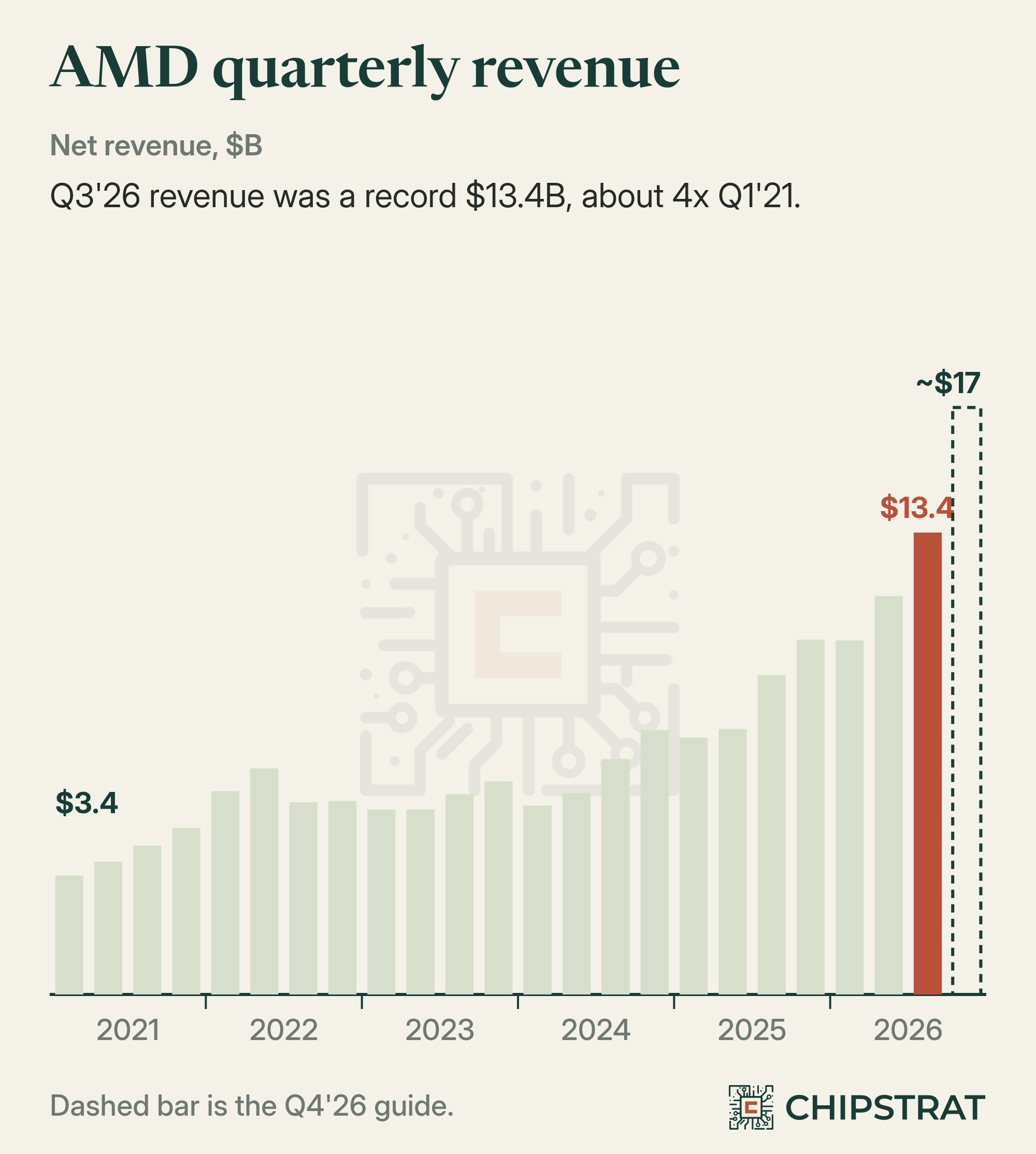
To all the Nvidia bagholders who always get on X whenever AMD has something good happen and write about how tiny AMD is compared to Nvidia, how grateful AMD should be to Nvidia for the AI craze, and so on… We can appreciate the greatness within every company! I’m happy when people do well in life, and that chart is a demonstration of a large company doing well. Nvidia obviously doing well. But let’s give AMD credit where credit is due!
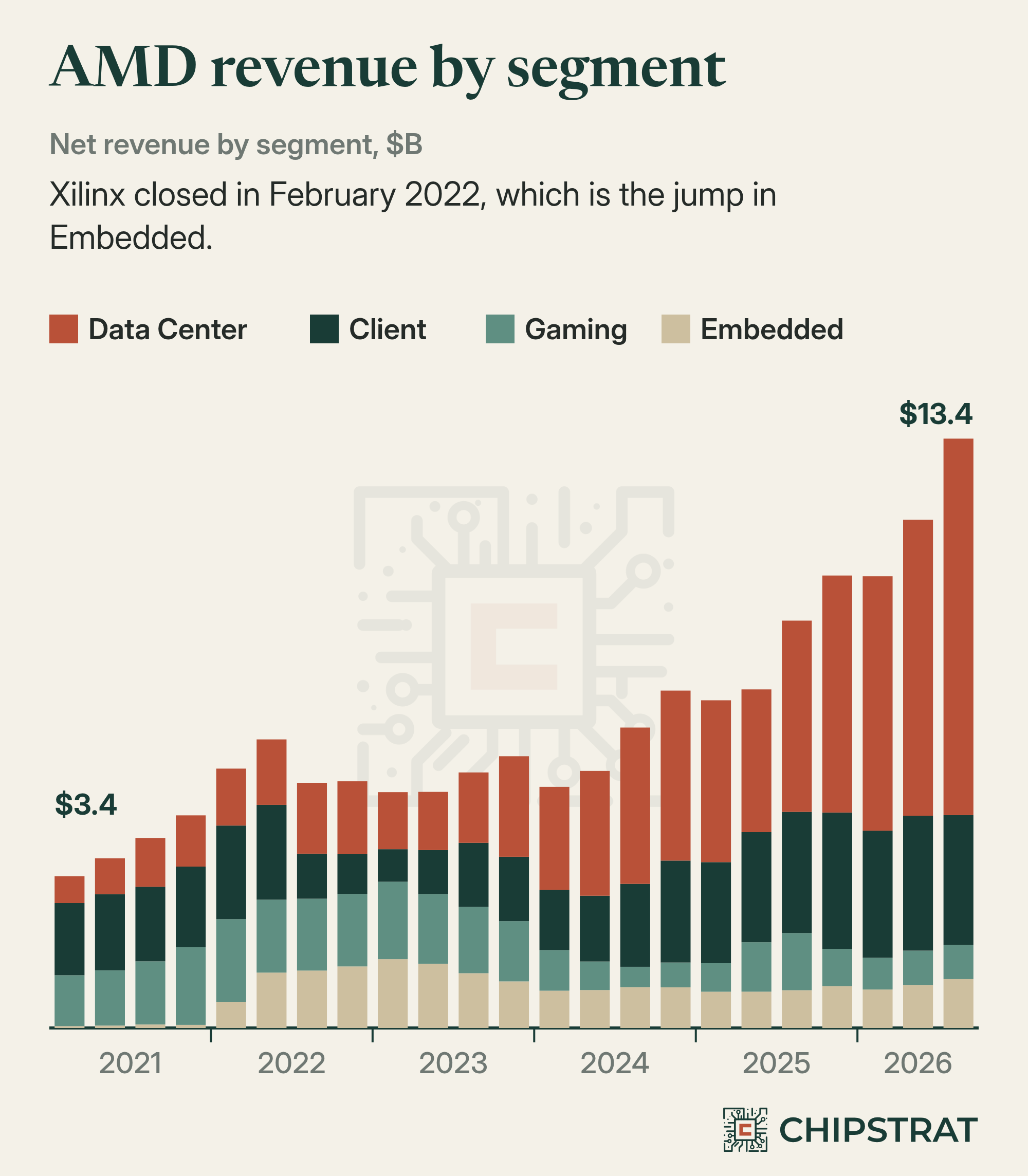
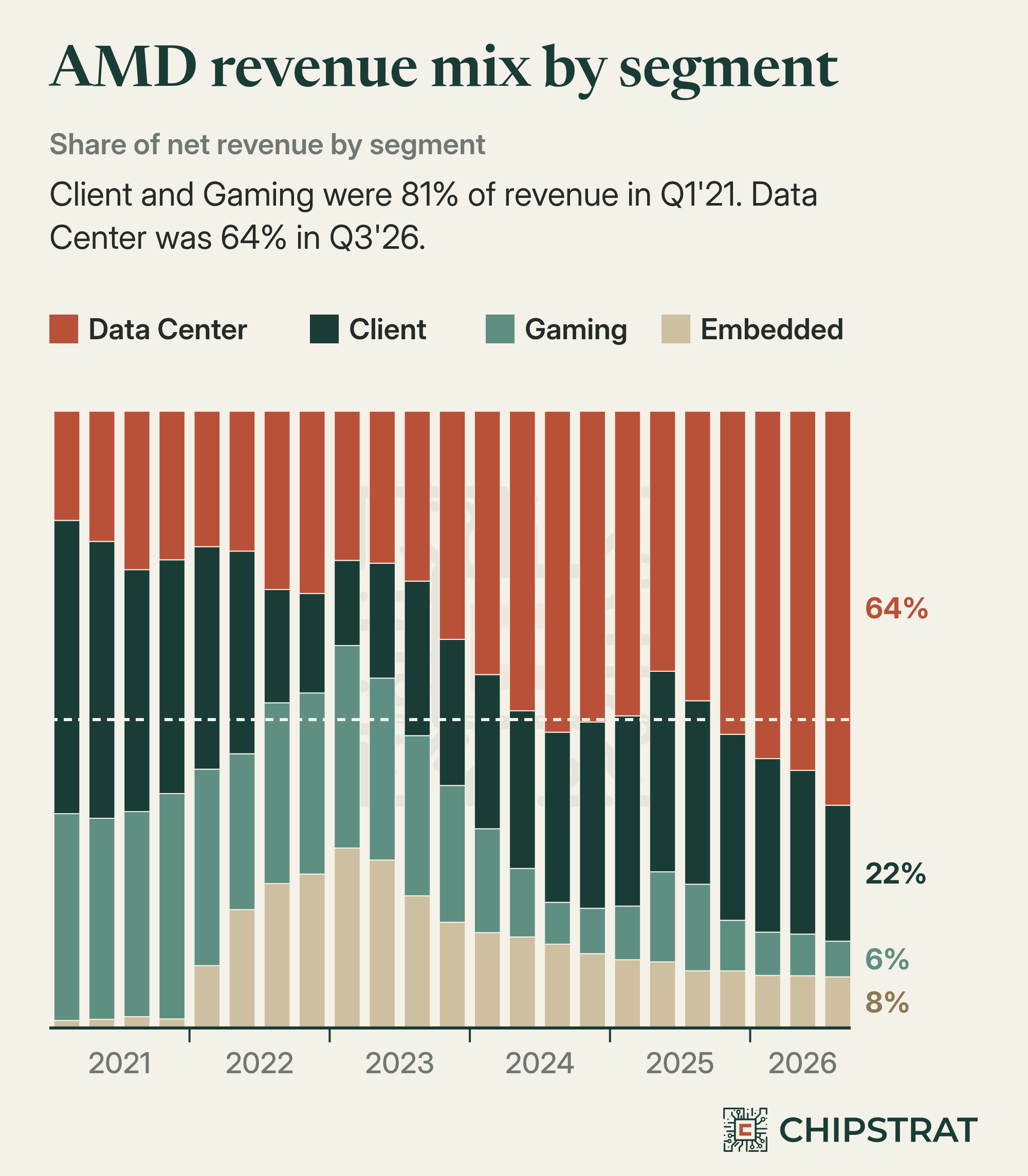
Fun to watch that data center line grow. As a share of net revenue:
Data center acceleration
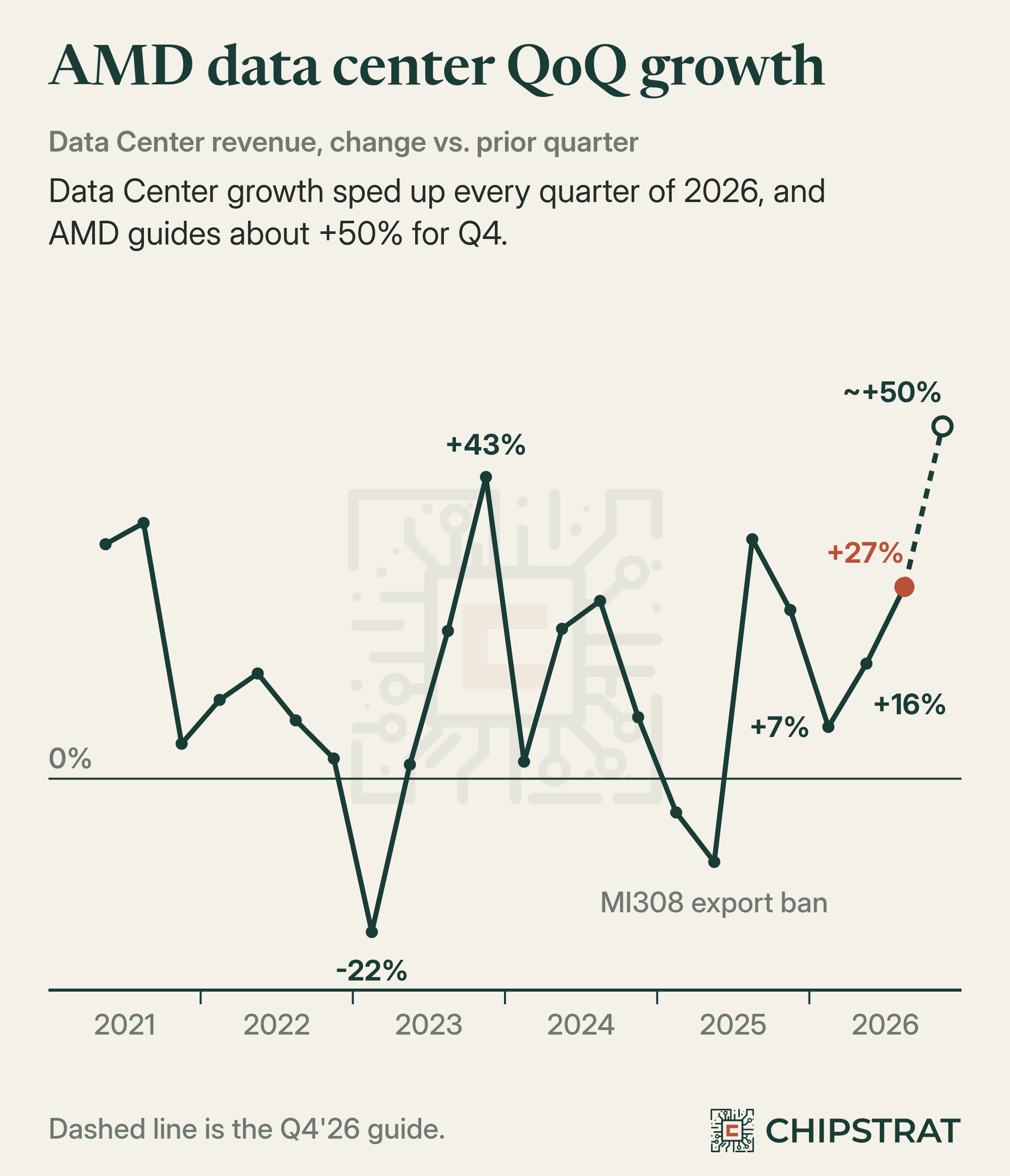
“We executed very well in the quarter with Helios production ramping as planned and EPYC adoption expanding across cloud, enterprise and super intelligence workloads. Data center revenue growth has accelerated sequentially every quarter this year, with the segment contributing 64% of total revenue in the third quarter, up from 47% just 1 year ago. We expect that acceleration to continue in the fourth quarter, driven by increased demand for inference and agentic workloads and the ramp of our newest products.”
Lisa Su, Chair and CEO
Note it has been choppy historically:
But what about ‘27?
AMD says it should be steady. In May, Lisa laid out the Helios ramp as initial volume in Q3, a significant ramp in Q4, and more growth in Q1. When Tim Arcuri asked on this call whether the GPU business would be lumpy, she said AMD expects both data center AI and server CPU “to grow nicely throughout the year”. Jean’s caveat was gross margin, which will move quarter to quarter with the mix of AI and server revenue. I’d personally not be surprised by some unevenness, as GW deals seem to ship in big tranches tied to when each customer brings data centers online.
Oh yeah, wanted to look at DC like this too as a line chart:
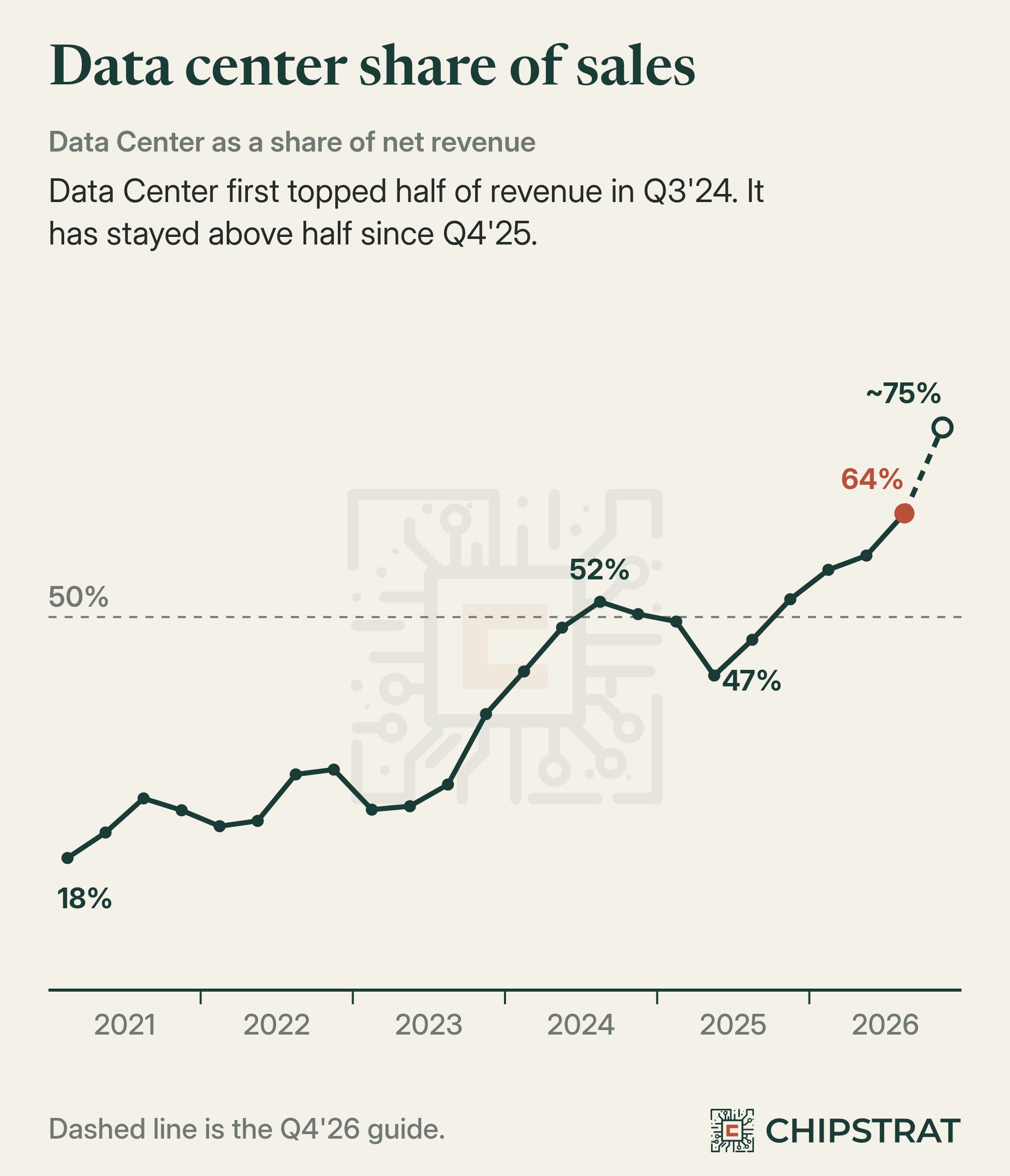
Again, beautiful.
Really, EPYC is carrying a lot of that, honestly, but nice teamwork between EPYC and Instinct.
Agents as the CPU killer app
“Cloud providers also added significant EPYC capacity in the quarter for personal and enterprise agents, which are quickly becoming the next killer app for CPUs in the cloud. Meta’s Muse and OpenAI’s Dots illustrate how quickly personal agents are growing with more than 10 million people activating Muse agents in the first 6 weeks. Enterprises are moving fast as well, putting agents to work across software development, supply chain and IT operations. These agents work continuously and in parallel across applications and enterprise systems, adding to accelerator demand while creating a substantial increase in CPU demand. Adoption is just starting, and we expect demand to grow sharply as agents are deployed more broadly and take on more complex work.”
Lisa Su, Chair and CEO
I like this framing of personal and enterprise agents as the killer app for CPUs in the cloud.
It’s why I’m still hung up on Intel not having enough server CPU capacity, even though it’s nuanced and challenging for them. But again, it’s the logical progression… after all, I wrote back in January of 2025 that “AI Agents = More CPUs”
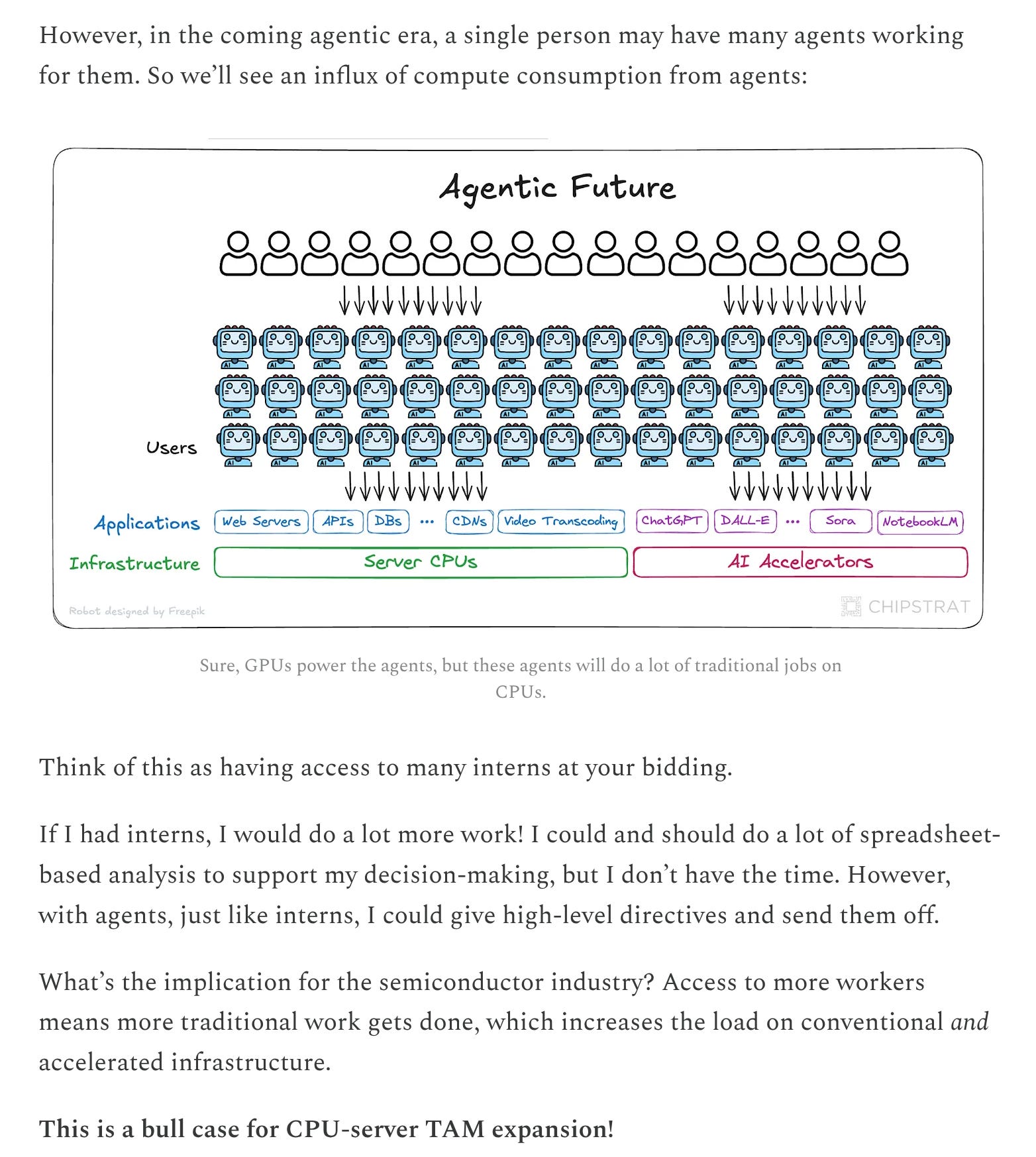
Back in January of 2025.
Not trying to toot my own horn too much but that was like 21+ months ago!
And memory was going crazy already back then too… so it’s not crazy to have today’s outcome in your forecast, even if agentic AI came on even stronger than we imagined.
Enough time to plan supply right?
Can EPYC host everyone’s XPU? Not everyone’s.
“In head nodes, we won major deployments with several of the largest model developers and cloud providers in the quarter, which will ramp over the coming quarters. EPYC’s leadership performance and mature ecosystem proven at scale have made it the host CPU of choice for custom accelerators. As 1 example, OpenAI selected Turin EPYC processors as the host CPUs for its first custom accelerator platforms.“
Lisa Su, Chair and CEO
OpenAI choosing Turin to host its own accelerator is a real win for EPYC. But Google hosts its TPUs on Axion, and AWS hosts Trainium3 on Graviton. So how many XPU sockets are actually open to AMD?
We’ll jump into that in the paid section. Then more thoughts and charts, including:
Why AMD and Intel sounded so different on supply in the same week
HBM costs, OpEx, and where gross margin goes once AI passes server in Q4
Taalas, World Labs, and co-design as AMD’s answer to custom ASICs
MI430X and the FP64 market
Helion, AMD’s CPU-first rack for agents, and best enterprise AI rack?
Venice ramp
more
Thanks for your financial support and for reading! Helps me do this full-time!